Introduction
For Indian students and their families, choosing to study in an MBBS overseas education is about more than just relocating; it’s about setting the foundation for a reputable medical career, safety, and future development. You now have to make one of the most important decisions: choosing an MBBS abroad country and university. This is after passing the NEET and knowing the main differences between MBBS in India and overseas (as discussed in Part 1).
With hundreds of universities and many nations ready for your attention, the alternatives are numerous. It is important to carefully consider factors including tuition costs, the language of instruction, official recognition, living expenditures, and climate. You’ll discover how to compare locations, confirm recognition, prevent awareness of regular mistakes, and make the most assured decision for your future in this informative guide.
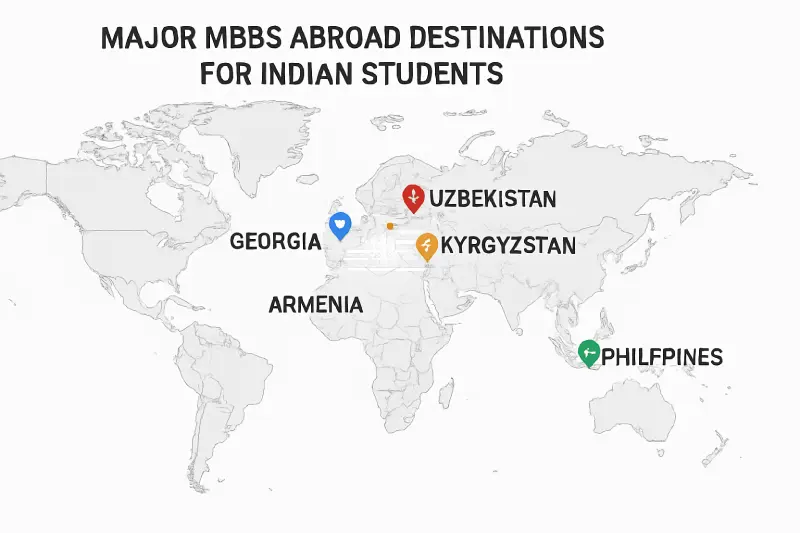
Best Countries & Universities for MBBS Abroad for Indian Students
It’s important to concentrate on locations with a solid reputation for Indian medical students when selecting the best country for MBBS abroad.
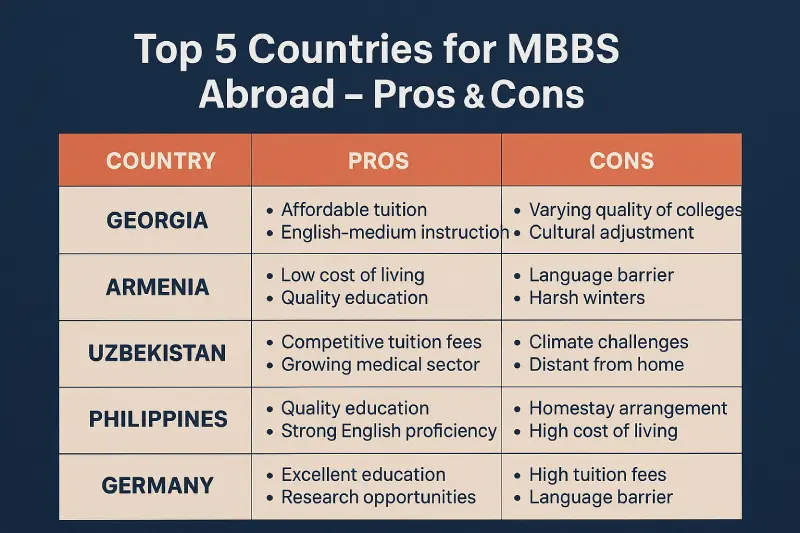
Georgia
Georgia provides affordable, excellent education in a balanced manner. Most MBBS courses are taught in English, and the total cost (including tuition and living) ranges from ₹25–38 lakh.
Students appreciate the modern hospitals, safe environment, and European-standard curriculum. Universities such as Georgian National University (SEU) are recognized by the NMC and WHO, making them a reliable choice.
Armenia
Armenia is unique because of its thorough MBBS program, affordability, and high quality of clinical instruction. It’s one of the best possibilities, with overall costs usually between ₹20 and ₹30 lakh, with food and hostel options suitable for Indian students.
Eligibility for FMGE/NEXT is simple because prestigious universities like Yerevan State Medical University offer degrees that are recognized by the WHO and NMC.
Uzbekistan
The medical institution system in Uzbekistan, which offers MBBS for around ₹15–25 lakh for the full program, is quickly becoming more and more popular among Indian students. Many universities offer instruction in English, but Russian is also widely used, so check the medium before applying.
Major government universities get the necessary NMC/WHO approvals, and well-established Indian communities facilitate acceptance of incoming students.
Philippines
The Philippines is Asia’s finest entry point for people interested in the American healthcare system. It offers an MBBS-like MD program that is designed for great FMGE success.
English is the main medium of teaching, which is a huge plus, and the fees range from ₹24 to ₹35 lakh. The lively student culture and sizable Indian communities assist with adjustment.
Kyrgyzstan
With tuition usually starting from ₹15 to ₹25 lakh, Kyrgyzstan is routinely ranked as one of the cheapest countries for MBBS. English is the primary language of instruction at government universities, which are approved by the WHO and NMC.
With their Indian mess and cultural groups, major towns like Bishkek are home to thousands of Indian students. However, new students should make sure the university is authentic before joining.
Important Factors When Choosing MBBS Abroad for Indian Students
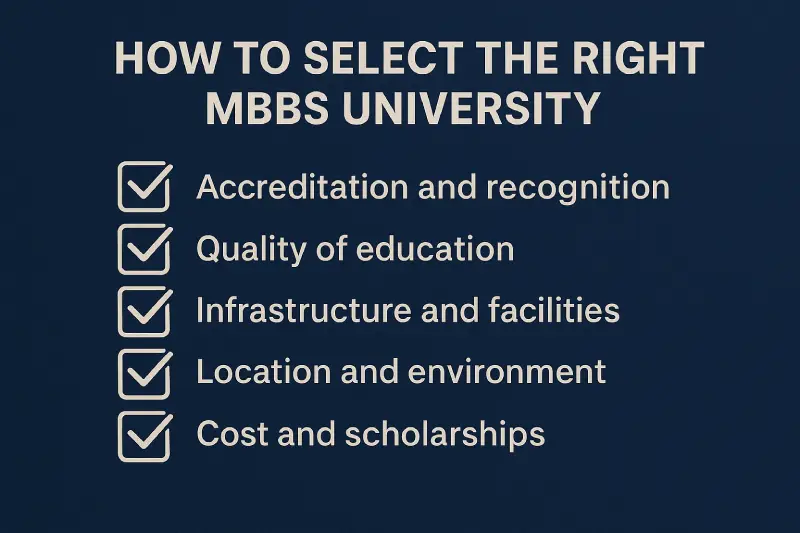
Living expenses and tuition fees
While the cost of tuition is an important consideration, the whole cost of an MBBS degree overseas includes living expenses, hostel and mess fees, health insurance, visa, travel, and personal expenses.
Georgia, for example, has strong city infrastructure, stronger hospital exposure, and slightly higher tuition costs. On the other hand, although Kyrgyzstan and Uzbekistan have the lowest total costs, further research is needed on hostel quality and local safety.
Teaching Language
Selecting an English-medium MBBS program is crucial for Indian students. Better exam scores and simpler FMGE/NEXT preparation arise from an understanding of English-language lectures, texts, and clinical contacts.
Unless your work ambitions require it or you have good language abilities, stay away from programs where the main language is Uzbek, Armenian, or Russian.
Acknowledgment and Recognition
The World Health Organization (WHO) and National Medical Commission (NMC) recognition determines the worth of your degree. only a few of the universities listed in the World Directory of Medical Schools and the NMC College Search web.
Make sure the university is listed on FAIMER or ECFMG if you’re thinking about pursuing a postgraduate degree in the US, UK, or another nation.
Adaptation to Climate and Culture
The climate affects your well-being, comfort, and ability to concentrate. Georgia and Armenia are great if you like mild weather. While Kyrgyzstan and Uzbekistan offer both warm and cold seasons, tropical enthusiasts will adjust to the Philippines.
Look into local food, festivals, traditions, and the existence of Indian communities. Learning and personal development are improved in an environment of care.
Internships and Clinical Exposure
Check the internship’s organization, patient volume, and hospital affiliations with the university where you will receive training. A major indicator of success on the FMGE/NEXT exam is extensive clinical exposure.
To find out about actual experiences, get FMGE pass data and get in touch with existing Indian students.
How to Verify WHO/NMC Recognition
For your medical career in and outside India, it is essential to confirm the recognition status of the university you have selected.
- NMC Recognition
- Select the nation and university names to search the NMC’s official website.
- Verify if the organization is listed as an accredited provider of international medical education.
- WHO/WDOMS Recognition
- Verify your university by going to the World Directory of Medical Education.
- Check regional regulatory listings if you plan to practice internationally (such as ECFMG in the US).
Checklist & Red Flags
- Do not apply to universities that are not on official listings.
- No proof of teaching hospitals or hospital partnerships.
- “Direct admission” advertising needs little paperwork.
- Absence of authentic input from present Indian students.
- Always talk to enrolled students, get information about teaching infrastructure and FMGE pass rates, and watch real videos or testimonials.
Common Problems to Avoid When Choosing a Country and University for an MBBS Abroad Program
- Choosing based only on cost: Low fees can lead to low FMGE/NEXT pass rates, limited labs, and poor hospital access.
- Ignoring Official Recognition: Your investment and years of study are wasted because degrees from unrecognized universities are not valid for an Indian license.
- Dependency on Unverified Education Agents: Apply via official university portals or only utilize reputable, verified consultancies.
- Ignoring Language Barriers: Programs that do not use English cause learning challenges and test issues.
- Missing Deadlines: Applications submitted after the deadline may be rejected or subject to modifications.
- Ignoring Hostel and Safety: Poor hostels have an impact on concentration, safety, and health. Always put the welfare of your students first.
- Considering Climate and Food: Adjustment and success may be impacted by comfort with the local climate or the lack of familiar foods.
Frequently Asked Questions (FAQ)
Q1- How can I determine whether a university is eligible for FMGE/NEXT?
Before applying, look over the official WHO and NMC lists. Your career may be at risk if you attend an unlisted university.
Q2- After enrolling, is it possible for me to transfer to another university?
Transfers are challenging and entail lost credits, money, and time. Make a smart decision right now.
Q3- Is joining a government university overseas preferable?
Higher FMGE pass rates, better resources, and safer living conditions are common advantages of government colleges.
Q4- Should MBBS abroad programs be in English?
For Indian students, yes. They guarantee easy exam preparation and comfortable learning.
Q5- Do all universities offer FMGE preparation?
Not always; find out if coaching is available for FMGE/NEXT before enrolling.
Conclusion
One of the most crucial decisions you will make in your medical career is choosing an MBBS abroad nation and university. You may guarantee not just a spot at university but also a stable, bright future by carefully considering aspects like costs, recognition, language, culture, safety, and clinical exposure, as well as by consulting official resources.
Use trusted education consultancies, establish a connection with actual students, and double-check everything to prevent expensive errors. With proper planning, your MBBS abroad journey can be both affordable and rewarding.
Next in this series of blogs:
Part 3: MBBS Abroad Admissions Process (Documents, Timeline & Steps)
After that, we’ll go over how to apply, what paperwork you’ll need, how to fulfil deadlines, and detailed approaches for enrolling in the MBBS program of your choice overseas.
Follow this website for professional advice on every stage of your medical admission abroad!