Introduction -The Dominance of Admission Guidance
The dream of studying medicine overseas is exciting, but understanding the MBBS Abroad Admission Process is what turns that dream into reality. Such a process can be compared to the marathon preparations: the desire is strong, however, without proper documentation, strategic planning and support, the journey can be tiring.
Between the preparation of the necessary papers to visa procurement, this step can be both smooth sailing and a significant setback, hence, in many cases, the availability of professional help or a consultant can be one of the factors that differentiate the path between confusion and clear understanding.
Step 1: Understanding the Foreign MBBS Admissions
The process of international MBBS admissions is systematic though remains a little different in various countries. In most cases, international universities want to check that you have fulfilled academic requirements, successfully passed NEET (in case of Indian students) and that you can afford yourself in a new country.
Eligibility requirements: A majority of institutions require that an individual possess a minimum cumulative percentage of 50% in Physics, Chemistry and Biology in the twelfth grade.
NEET qualification: A mandatory exam of Indian students who want to pursue medicine in foreign countries.
Countries differences: There are some countries, like Russia, which require documents to be translated with notarize, and some such as Georgia require an Apostille certification.
Step 2: Documents To Admission
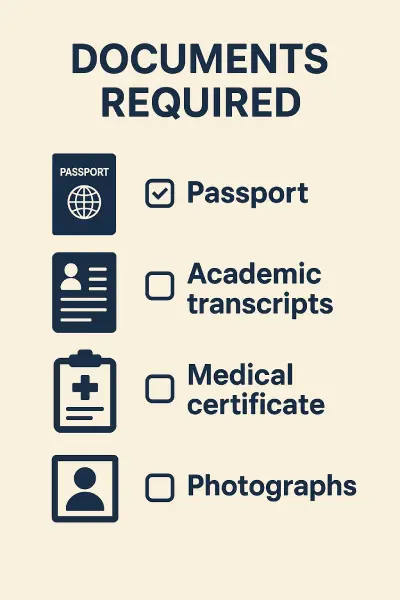
Preparation of documents is like packing before travelling; forget something and you will end up at the boarding gate. The following is a detailed checklist that any future MBBs student in a foreign country must have:
Academic Qualifications: 10 th and 12 th marksheets and certificate of completion.
NEET Scorecard: A mandatory requirement of Indian applicants.
Passport: This requires that the passport be valid, otherwise delays in application are likely to follow.
Identification: Aadhar card, PAN card or other government issued identification.
Medical Fitness Certificate: In some universities, it requires medical evidence of good health.
Financial Statements: Bank statements showing the ability of the applicant to take care of his/her expenses.
Passport-Size Photographs: This is generally in 10-15 copies over white background.
Temporary guideline: It is possible to recommend the attestation of every document in order to exclude late-night legal obstacles.
Step 3: Confirmed Timeline of Admission
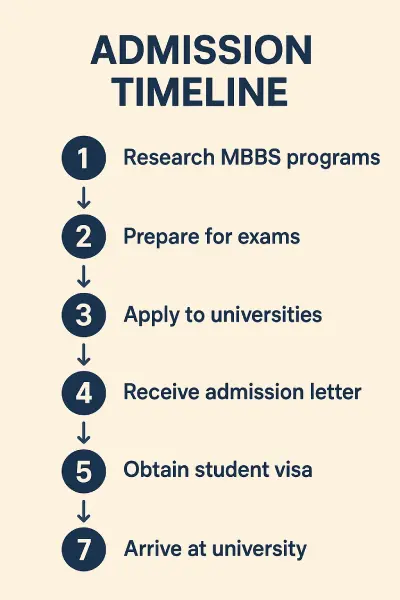
At first, the admissions process appears difficult, but when broken down into step-by-step it feels more like climbing stairs than going up a slope. It usually goes like this:
Application Submission: Applicants or their consulting firms submit documents to the universities.
Offer Letter: Once the eligibility is met, the only thing to do is to issue an admission letter within 7-10 working days.
Payment Fee: The first payment submitted is fee to secure the seat.
Invitation & Visa Process: This is an invitation letter issued by the university as falls into the student visa application.
Visa Approval: It is usually done in 2-4 weeks but it depends on the embassy.
Travel Preparation: This involves booking a flight, booking a place where to stay, changing money and packing the necessary.
University Joining: Orientation session is taken in the first week after the arrival.
Step 4: How Consultants Make the Admissions Process Easier
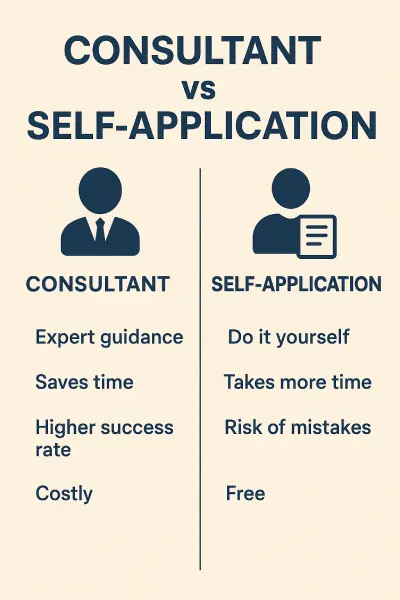
Not all applicants are capable of navigating such challenging conditions on their own without assistance. A consultant is something like the expert guide because he knows the best ways, falls and the ways to be safer. The roles played by the consultant include:
- Forms: To fill in to arrange meetings with embassy sports.
- Reducing errors: Ensuring that your papers are well done without errors.
- Direct contact with universities: Consultants are often directly in contact with universities, and this accelerates the process.
- Visa Preparation: Pretender role opuses and seminars prior to face-to-face meetings at the embassy.
- Pre-departure: Adapting to the new culture, what to bring, what to expect in the campus.
Real Student Case Studies – Success Stories
Hi, my name is V.M. Dakshani. I’m studying at Tashkent Medical University in Uzbekistan. The reason I came to Uzbekistan is because of the Annamalayar Education Trust. I met Mr. Madhan sir and he cleared all my doubts. He took care of all my processes. I was able to pay my budget for 6 years. With food and hostel, I was able to pay 35 lakhs. This country is a very safe country, mainly for girls.
The process is from 1st year to 6th year. From Chennai to Tashkent, Annamalai Education Trust takes care of us. Visa to Passport. Tashkent Medical Academy is from Government College. So, for Hostels, Mess takes care of Annamalayar Education Trust. So, you won’t feel like you are missing out on Tamil food. I have come to Chennai for my second-year vacation. In the first year, you will have 18 subjects in anatomy, physiology and zoology. You will study not only in theory, but also in practical.
Challenges Students Face During Applications Process
- Missed the deadline of applications because of confusion.
- Declines of visas due to unfinished applications.
- Legalisation of the documents (notary and embassy attestation).
- Parental International communication problems.
Why Consultant Support is the best
The consultants may be figured as Google Maps to foreign MBBS admission; without that guidance there will always be a number of wrong turns. They provide the following advantages:
- Time savings.
- Stress reducing to parents.
- Ensure that embassy and university rules are met.
- Student and parent morale increased.
Checklist Before You Apply for MBBS Abroad
However, prior to applying to MBBS Abroad, this is the checklist.
For official guidelines, check the National Medical Commission (NMC) website and Ministry of External Affairs
Conclusion – The MBBS Abroad Dream is Within Reach
Learning medicine abroad is not a process consisting of people chasing their own long-term dream; the creation of a meaningful life. The process of MBBS admission and application can come across as a daunting challenge, but with proper documentation, timeline awareness, and the consultant taking part in the process, it can turn out to be a realistic possible task. This is like walking on a well-built bridge instead of shaking the ropeway, hence this process is safer, and full of direction.
Frequently Asked Questions (FAQs)
Normally 50% in Physics, Chemistry, and Biology; 40% in reserved classes.
Yes. To become an doctor, Indian students need to clear NEET.
Theoretically, 6-8 months before the intake session.
Application can be made, though the visa process has to wait until the new passport is obtained.
As a rule 2-4 weeks, subject to embassy activity.
They are not legally required, but they definitely improve efficiency, speed of action, and minimize errors.
Yes, provided you have good cause, and with documentation.
Even mistakes or lack of documentation, can lead to rejection; university only accepts based on their eligibility.