NEET Qualified but No Government Seat? Your MBBS Options in 2026
Close to 13 lakh students qualified NEET last year. Yet India has only about 1.2 lakh MBBS seats. Government colleges hold barely half of those. So the maths is brutal. Lakhs of qualified students finish counselling with nothing in hand. If that is you right now then take a breath. Your qualification is not wasted. In fact your MBBS options after NEET are wider in 2026 than they have ever been. Private and deemed universities are one route. MBBS abroad in Georgia and Uzbekistan is another. Then there are respected alternative medical courses. Meanwhile a structured drop year fits certain students better than any paid seat. This guide walks through every path with honest costs and clear rules. By the end you will know exactly which door to knock on next.
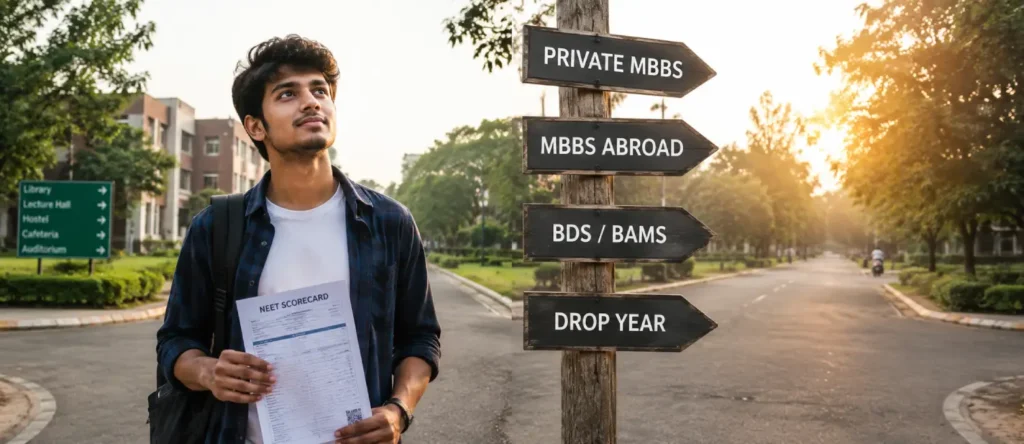
NEET Qualified but No MBBS Seat? Here Is Why It Happens
Picture a student from Coimbatore. She scored 512 in NEET. Her family celebrated for a week. Then counselling started. Round one passed. Round two passed. The mop up round closed. Still no government seat. No one told her that a 512 rarely crosses the general category line for a government MBBS seat in Tamil Nadu.
Her story repeats across India every single year. Because the cutoff for government seats keeps climbing while seat numbers grow slowly. A score that earned a seat five years ago may not even come close today. So being NEET qualified but no MBBS seat in hand is not a personal failure. It is simple arithmetic.
The good news? Qualifying NEET unlocks every single pathway below. Your scorecard is the key. Now you just need to pick the right lock. Let us look at each of the serious MBBS options after NEET one by one.
Private MBBS Colleges After NEET: The Deemed University Route
Private MBBS colleges after NEET remain the most direct backup for families who can afford them. These include deemed universities counselled by MCC and private colleges counselled by state DME authorities. Your NEET score still matters here. However the cutoffs sit far below government levels.
Two things make this route attractive. First you stay in India close to family. Second the degree carries zero foreign licensing hurdles. You graduate and you practise. That simplicity is worth something.
But there is a catch and it is a big one. Cost. Which brings us to the quota system.
Management Quota MBBS Admission: How It Actually Works
Management quota MBBS admission is the portion of seats a private college fills at higher fees. Roughly 15 percent of seats in most private colleges fall under this quota. NRI quota seats sit on top of that at even higher prices.
Walk through it and the route becomes clear:
- Register on the MCC portal for deemed universities or your state DME portal for private colleges
- Fill your choices during each counselling round
- Pay the security deposit before the deadline
- Verify the college on the NMC approved list before paying a single rupee
- Collect a proper fee receipt for every payment
Never pay any agent who promises a confirmed seat outside counselling. There is no such thing. Every legitimate MBBS admission through management quota flows through official counselling. Anyone who says otherwise is selling you a scam.
The Real Price of MBBS Admission Through Management Quota in 2026
Now for the honest numbers. Sit down before you read this table.
| Seat Type | Total 5.5 Year Cost | Who Counsels It |
|---|---|---|
| Deemed university (management) | ₹80 Lakhs to ₹1.5 Crores | MCC |
| Private state college (management) | ₹60 Lakhs to ₹1 Crore | State DME |
| NRI quota | ₹1.2 Crores to ₹2 Crores+ | MCC / State DME |
In the majority of colleges these amounts stop at tuition. Hostel and mess charges come extra. So a family should budget the full amount before locking a seat. Otherwise a mid course fee crisis can wreck everything. For many households this is where the best MBBS options after NEET shift overseas. Time to cross that border.
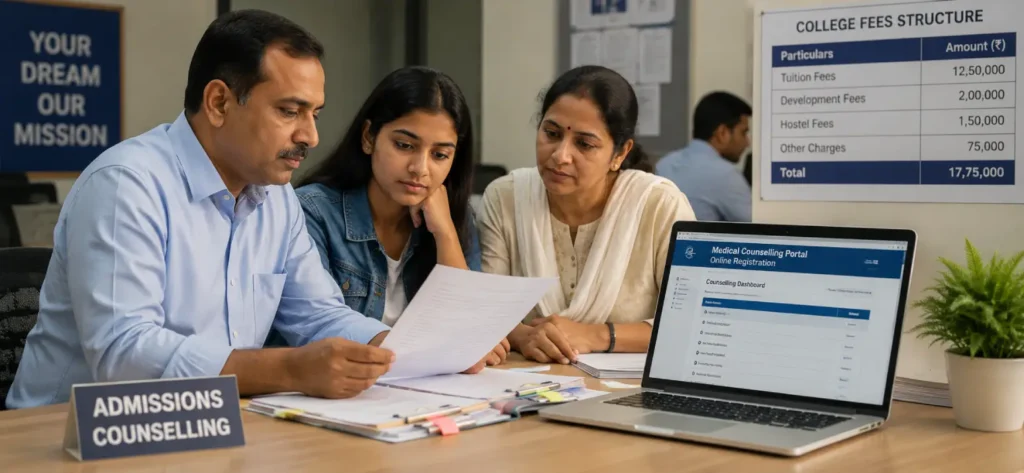
MBBS Abroad After NEET: Why Georgia and Uzbekistan Stand Out in 2026
MBBS abroad after NEET has moved from a last resort to a first choice for thousands of Indian families. The reason is plain. A complete foreign MBBS frequently costs no more than what one year under management quota drains in India.
Dozens of countries accept Indian students. Yet in 2026 two destinations stand clearly ahead of the pack for value and safety. Georgia and Uzbekistan. Both offer English medium programs. Both welcome large Indian student communities. And both fit the ₹25 to ₹50 Lakh total budget that most middle class families can actually manage. Among all MBBS options after NEET this pairing gives you Europe on one side and Central Asia on the other. Let us break each one down.
MBBS in Georgia After NEET: The European Option
Georgia sits at the edge of Europe with a medical education system that has quietly built a strong reputation among Indian students. Tbilisi State Medical University and David Tvildiani Medical University are the names you will hear most often.
Why do students keep choosing Georgia?
- Full English medium instruction from day one
- Six year program including a clinical internship
- Total cost of roughly ₹30 to ₹45 Lakhs including living expenses
- No entrance exam beyond your NEET qualification
- Safe cities with a visible Indian student population
- Visa process that is simpler than most European countries
Winters are cold but manageable. Indian mess facilities operate near most major campuses. Also flights from India route through Delhi or Sharjah in under eight hours. For a family that wants a European degree without European price tags Georgia delivers.
MBBS in Uzbekistan After NEET: The Budget Friendly Contender
Meanwhile Uzbekistan has become the fastest growing destination on the map. Tashkent Medical Academy and Samarkand State Medical University lead the pack. Both are government universities with decades of history.
The pitch is simple. Uzbekistan gives you a full MBBS at the lowest credible price point available anywhere. Total costs land between ₹20 and ₹35 Lakhs for the entire course including hostel. That is less than a single year at many deemed universities in India.
Distance helps too. Tashkent is barely three hours from Delhi by air. The food culture overlaps with North Indian cuisine. Plov and biryani are practically cousins. Several universities have also signed academic partnerships with Indian institutions which means Indian faculty visit for clinical training modules. So the culture shock stays low while the savings stay high.
Here is how the two countries compare side by side:
| Factor | Georgia | Uzbekistan |
|---|---|---|
| Total cost (approx.) | ₹30–45 Lakhs | ₹20–35 Lakhs |
| Flight time from India | 6–8 hours | 3–4 hours |
| Medium | English | English |
| Course length | 6 years | 6 years |
| Climate | Cold winters | Moderate, hot summers |
| Vibe | European city life | Central Asian, closer to home |

NMC Rules Every MBBS Abroad After NEET Student Must Check
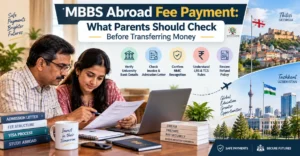
Before you fall in love with any campus abroad you must clear one filter. The NMC Foreign Medical Graduate Licentiate Regulations 2021 set the ground rules for every Indian studying medicine overseas. Miss these and your degree becomes decorative paper.
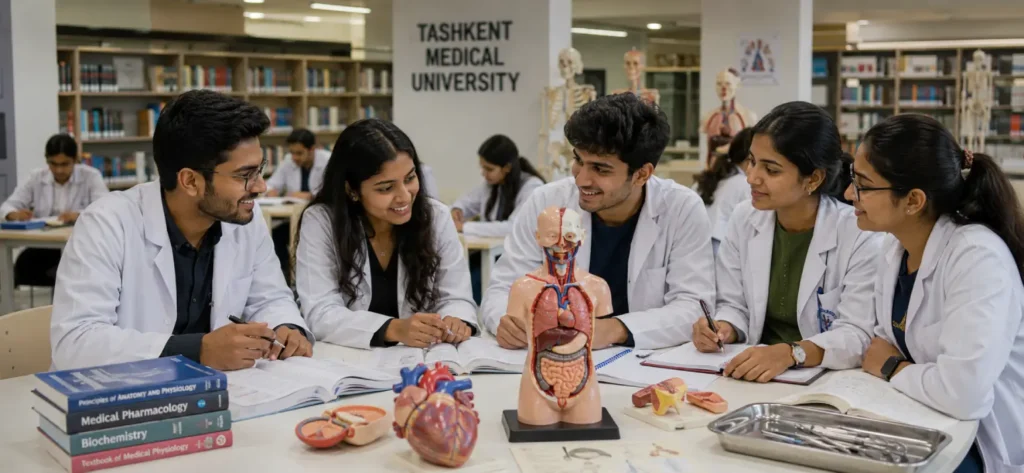
The non negotiables:
- The course must run at least 54 months
- A 12 month internship must follow in the same foreign university
- The entire program must be taught in English
- You must be eligible to practise medicine in that country after graduating
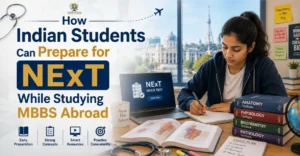
Then comes the licensing exam back home. Today that exam is FMGE. The NExT exam is set to replace it once NMC rolls it out fully. Either way the smart move is to start structured preparation early rather than cramming in your final year. Many students begin NExT focused coaching alongside their MBBS abroad so the licensing exam never becomes a roadblock. Treat the exam as part of the course and not an afterthought. That single mindset shift separates the students who practise in India from the ones who stall.
Alternative Medical Courses After NEET: Respected Careers Beyond MBBS
Stop for a second. Ask yourself one honest question. Do you want to be a doctor or do you specifically want the letters MBBS? Because alternative medical courses after NEET produce real practising doctors every year. And their cutoffs sit well below MBBS levels.
Consider these four:
- BDS. Dentistry. Five years including internship. Private practice potential is strong in growing cities.
- BAMS. Ayurveda. Government AYUSH hospitals recruit actively and wellness demand keeps rising.
- BHMS. Homeopathy. Low setup cost for your own clinic after graduation.
- BUMS. Unani medicine. A smaller field which means less competition for government posts.
Each of these uses your existing NEET score. Each leads to the title of doctor. Each costs a fraction of a management quota MBBS seat. So before you drain the family savings weigh these paths seriously. For plenty of students an alternative course beats every other option on this list. Still it is only one branch of the full tree of MBBS options after NEET and it will not suit everyone. If your heart is set on MBBS itself then read the next section carefully.
The Drop Year: A Bold MBBS Option After NEET Border Cases Should Consider
Here is a truth most consultancies will not tell you. Sometimes the smartest move is to wait.
If your score landed within 30 to 40 marks of the government cutoff then a structured drop year has excellent odds. Thousands of repeaters convert near misses into government seats every cycle. A government seat saves your family upwards of ₹60 Lakhs compared to private MBBS colleges after NEET. That saving justifies twelve months of focused work.
But a drop year only works with rules. Join a proper test series. Fix a daily schedule and defend it. Cut social media to the bone. And set a hard limit of one repeat attempt. Because a second or third drop starts eating the very career years you are trying to protect. If your gap from the cutoff exceeds 100 marks then be honest with yourself. Your energy is better spent on the abroad route or an alternative course than on rolling the dice again.
How to Choose the Best MBBS Options After NEET: A 3 Question Filter
By now you have five doors in front of you. So how do you pick? Run every choice through three questions. Your answers will point to one clear path almost every time.
Question 1. What is your NEET score really worth? Pull last year’s closing ranks for your category and your state. If you sit near the government cutoff then a drop year deserves thought. If you sit far below it then look outward without guilt.
Question 2. What can your family truly spend? Not stretch. Not borrow against the house. Spend. Above ₹80 Lakhs opens management quota MBBS admission in India. A ₹25 to ₹50 Lakh budget points straight to Georgia or Uzbekistan. Under ₹20 Lakhs makes alternative courses the practical winner.
Question 3. Are you genuinely open to studying abroad? Six years is a long time. Some students thrive overseas and grow tremendously. Others struggle with homesickness in month two. Know yourself before you book a flight.
Answer all three honestly and the fog lifts. And if you want a second pair of eyes on your specific score and budget the counsellors at Annamalayar Education map out these decisions for students every admission season. A thirty minute conversation now can save you thirty lakh rupees later. Whatever you decide make the decision on paper with real numbers. The best MBBS options after NEET are the ones that match your rank and your bank. Not the ones with the shiniest brochure.
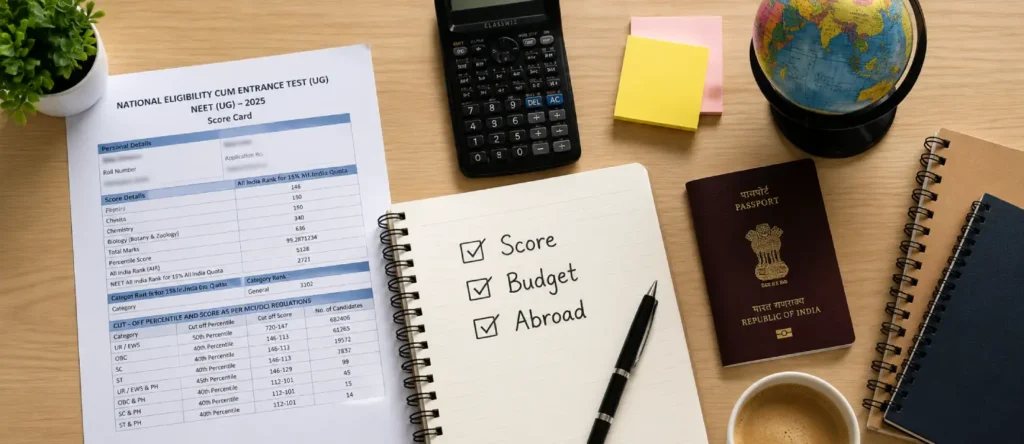
FAQs on MBBS Options After NEET
Yes. Management quota cutoffs run far below government cutoffs. Even scores in the 200 to 400 range secure seats in many private and deemed colleges. Just confirm the college appears on the NMC approved list and route everything through official counselling.
Completely valid provided you follow NMC rules. Study in an English medium program of at least 54 months plus a 12 month internship in the same university. Then clear the FMGE or the NExT exam once it launches. After that you register and practise like any Indian graduate.
Neither wins outright. Georgia costs a little more and gives you a European setting with strong global exposure. Uzbekistan costs less and sits just three hours from Delhi with a familiar food culture. Pick Georgia for the environment. Pick Uzbekistan for maximum savings.
For many students yes. BDS and BAMS graduates build solid clinical careers and government AYUSH recruitment keeps expanding. If your budget rules out private MBBS colleges after NEET and you do not want to go abroad then these courses give you a doctor’s career at a fraction of the cost.
Check your distance from the cutoff. Within 30 to 40 marks a single disciplined drop year is a sound bet. Beyond 100 marks the odds turn against you and a confirmed seat today beats an uncertain seat tomorrow. Set a one attempt limit either way and commit fully to whichever path you choose.