10 Questions Every Parent Should Ask Before Paying MBBS Abroad Fees
Every year, thousands of Indian parents transfer lakhs of rupees abroad within days of shortlisting a university. The excitement of an MBBS seat overseas often rushes past one simple step. Nobody sits down and checks what the MBBS abroad fees actually cover. Georgia and Uzbekistan have become two of the most trusted destinations for Indian medical aspirants right now. Low tuition, English-medium courses and NMC-listed universities pull families in fast. But a fast decision on MBBS abroad fees can turn into slow financial regret later. This guide breaks down the exact questions every parent must ask before wiring a single rupee. It focuses only on Georgia and Uzbekistan, the two countries most Indian families are actively comparing today.
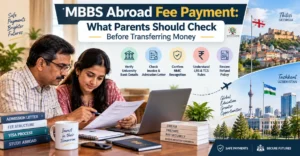
MBBS abroad fees for Indian students have grown into a serious research topic over the last few years. Parents no longer rely on a single agent’s word. They cross-check, they call other parents, and they read every clause before signing. That’s the habit we want every family working with us to build too. Ask these ten questions before you pay, not after.
Question 1: Is the University Recognised Before You Pay MBBS Abroad Fees?
No parent should release MBBS abroad fees before checking recognition status first. A university can look impressive on its website and still fail to qualify a student for practice back home. That’s why this check comes before every other check on this list. Skip it, and nothing else here really matters.
Start with the World Directory of Medical Schools, known as WDOMS. Then confirm the university meets the latest NMC and FMGL requirements set for Indian students. After that, verify the university carries valid recognition inside its own country too, not just an international listing. A college can appear on one register and still lack full domestic accreditation.
- Check the university’s WDOMS listing directly on the official portal
- Confirm current NMC and FMGL eligibility for that specific college
- Verify local government recognition in Georgia or Uzbekistan
- Ask the consultancy for the recognition certificate in writing
A quick phone call to the university’s international office often reveals more than a glossy PDF ever will. Ask them to email the recognition certificate directly to your own inbox, not through a middleman. If they hesitate or delay, treat that as a warning sign before any MBBS abroad fees leave your account.
Question 2: What Is the Real MBBS Abroad Total Cost, Not Just Year One?
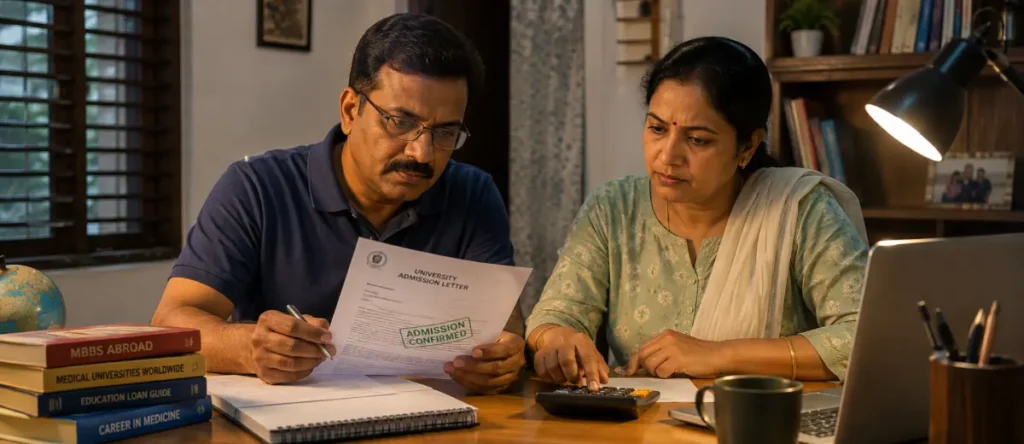
We’ve heard versions of this story more than once. A Coimbatore family paid the first year of MBBS abroad fees happily. The number felt small compared to private colleges in India. Then year two arrived. Hostel charges jumped. Insurance renewed at a higher rate. A “one-time” administrative fee appeared out of nowhere. Their MBBS abroad total cost had quietly doubled the original budget they had planned for.
This happens more often than parents expect. Universities sometimes quote only the first-year figure during counselling calls. So always ask for the complete 5 to 6 year breakdown before you commit to any MBBS abroad fees. Request it in writing, year by year, not as a rounded average.
- Ask for a full year-wise fee chart covering the entire course
- Request the figure in both local currency and Indian rupees
- Confirm whether fees rise each year or stay fixed
- Get the total in a signed document, not just a verbal promise
Here’s the pattern we see again and again: the real MBBS abroad cost rarely matches the number printed on the first offer letter. It usually sits a little higher once hostel, insurance and yearly increases get added in. Budget for the higher end of any estimate, not the lower one.
Question 3: What Do the MBBS Abroad Tuition Fees Actually Include?
Tuition fees rarely mean the same thing at every university. Some colleges bundle hostel and food into the quoted number. Others charge tuition alone and leave everything else separate. So parents must ask a direct question before agreeing to any MBBS abroad fees. Does this figure cover only classroom teaching, or does it include hostel, food, insurance and clinical training too?
Georgia and Uzbekistan remain the two most searched destinations for Indian MBBS aspirants this year, mainly because their MBBS abroad tuition fees look lower on paper than many other countries. That said, the real comparison only works once hostel and living costs get added in. Here is a general range to use as a starting point, not as gospel. Always confirm exact numbers directly with the university before paying anything.
Ask specifically what happens if a payment arrives a few days late. Some universities charge a penalty on delayed instalments, while others simply extend the deadline without any fuss. That single clause can matter a lot when international transfers hit unexpected banking delays.
| Cost Component | Georgia (Approx. per year) | Uzbekistan (Approx. per year) |
|---|---|---|
| Tuition fees | ₹3.82 lakh – ₹6.68 lakh | ₹3.34 lakh – ₹5.72 lakh |
| Hostel and food | ₹1.43 lakh – ₹2.39 lakh | ₹1.14 lakh – ₹1.91 lakh |
| Insurance and visa | ₹28,620 – ₹57,240 | ₹23,850 – ₹47,700 |
| Estimated 6-year total cost | ₹30 lakh – ₹45 lakh | ₹28 lakh – ₹42 lakh |
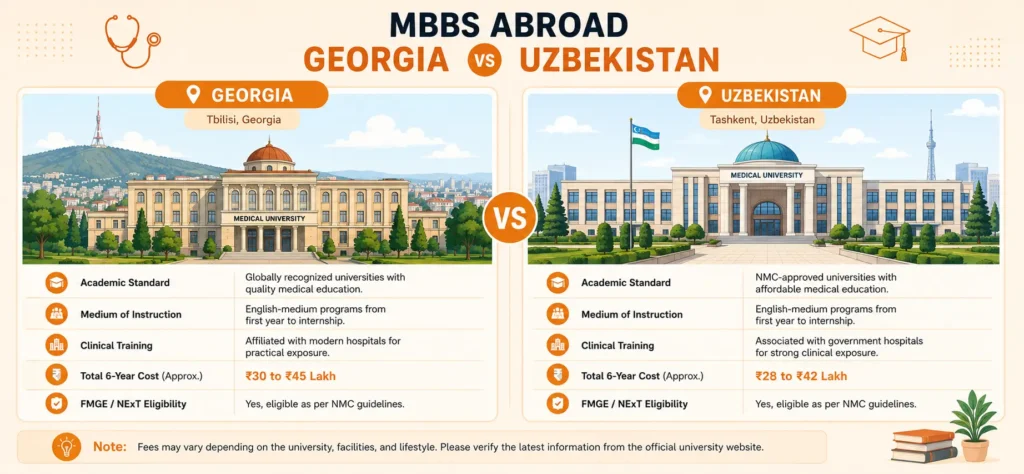
Numbers shift every admission cycle, so parents should always confirm the latest MBBS abroad tuition fees with the official university office rather than relying on last year’s brochure.
Question 4: How Do MBBS Abroad Fees in India Compare With Studying Overseas?
Private medical seats in India under management quota often cross ₹50 lakh, and many now cross ₹90 lakh for the full course. That single fact pushes most Coimbatore and Tamil Nadu families toward Georgia and Uzbekistan in the first place. Once you place MBBS abroad fees in India against fees in these two countries side by side, the gap becomes obvious.
Still, cost alone should never be the only reason for choosing a country. A cheaper MBBS abroad total cost means little if the degree does not clear FMGE or NExT later. We track fee changes across intake cycles for both countries, and parents researching this comparison in depth can explore detailed country-wise breakdowns at Annamalayar Educational Trust.
When families compare MBBS abroad fees by country, they often assume every low-cost option carries the same value. That assumption can be costly. Georgia and Uzbekistan both offer genuine savings over private Indian colleges, but the savings only hold up if the university clears every recognition check covered earlier in this article.
Question 5: What MBBS Abroad Hidden Costs Should Parents Watch For?
Hidden costs rarely show up in the glossy brochure. They show up in year two, year three, and often right before an exam. Parents who ask about MBBS abroad hidden costs upfront save themselves a painful surprise later, and their overall MBBS abroad fees stay closer to the original plan.
Here is a short, punchy list worth keeping on your phone during every counselling call.
- Document translation and notarisation charges
- Visa renewal fees, usually annual, not one-time
- FMGE or NExT coaching after the course ends
- Flight tickets home during breaks
- Local transport and mobile recharge costs
- Bank transfer and currency conversion charges
None of these look large alone. Added together across six years, they can quietly stretch the family budget by several lakh rupees. A written, itemised cost sheet beats a friendly verbal promise from an agent, every time.
Question 6: What Are the MBBS Abroad Living Expenses in Georgia and Uzbekistan?
Living costs shape the real MBBS abroad living expenses far more than most parents assume, and they belong in every MBBS abroad fees calculation from day one. Tbilisi and Batumi in Georgia carry slightly higher rent than smaller Georgian cities. Tashkent in Uzbekistan tends to run a touch cheaper for groceries and local transport, though prices still vary by neighbourhood and season.
A student in Georgia typically spends between $150 and $250 a month on food, transport and personal expenses outside hostel fees. A student in Uzbekistan usually spends slightly less, closer to $120 to $200 a month. Winters push heating costs up in both countries. Ask any December-batch student and they’ll tell you the heating bill is the one thing nobody warned them about.
Cooking at home instead of eating out daily can trim MBBS abroad living expenses noticeably over a full academic year. Many Indian students form small cooking groups within their hostel block, which also helps with homesickness during the first few months away from family.
Question 7: How Should Parents Pay MBBS Abroad Fees Safely?
Payment method matters just as much as payment amount. Always pay directly to the official university bank account whenever the process allows it. Avoid transferring large sums into a personal account belonging to an agent or a local representative, no matter how trusted that person seems.
Ask for a refund and cancellation policy in writing before the first payment goes out. The National Medical Commission publishes guidance at NATIONAL MEDICAL COMMISSION that families can cross-check before finalising any MBBS abroad fees transfer.
- Confirm the bank account belongs to the university, not an individual
- Keep every payment receipt and transaction reference number
- Get the refund policy signed and stamped, not just emailed
- Ask what happens to fees paid if a visa gets rejected
Involve your bank’s international transfer desk early. Many banks flag large first-time transfers abroad for manual review, which can delay a payment deadline by a few days if you have not planned for it.
Question 8: Is English-Medium Education Real for the MBBS Abroad Fees You Pay?
Many universities promote English-medium MBBS abroad fees packages, yet the reality on campus sometimes differs. Theory classes in the first two years often run fully in English. Clinical years later on can shift toward the local language at certain hospitals, especially during ward rounds and patient interaction.
Ask specifically whether every year, not just the early years, runs in English. Request to speak with a current student from India studying at that exact campus, not a general representative. Based on the placements we’ve handled in Georgia and Uzbekistan, we keep updated notes on which hospitals maintain consistent English instruction throughout all six years, and share them at Annamalayar Educational Trust – MBBS in Abroad.
A short video call with a senior batch student usually settles this question faster than any brochure. Ask them directly whether professors switch to the local language during ward rounds, since that detail rarely appears in official material.
Question 9: What Clinical Training Backs Your MBBS Abroad Fees in Georgia and Uzbekistan?
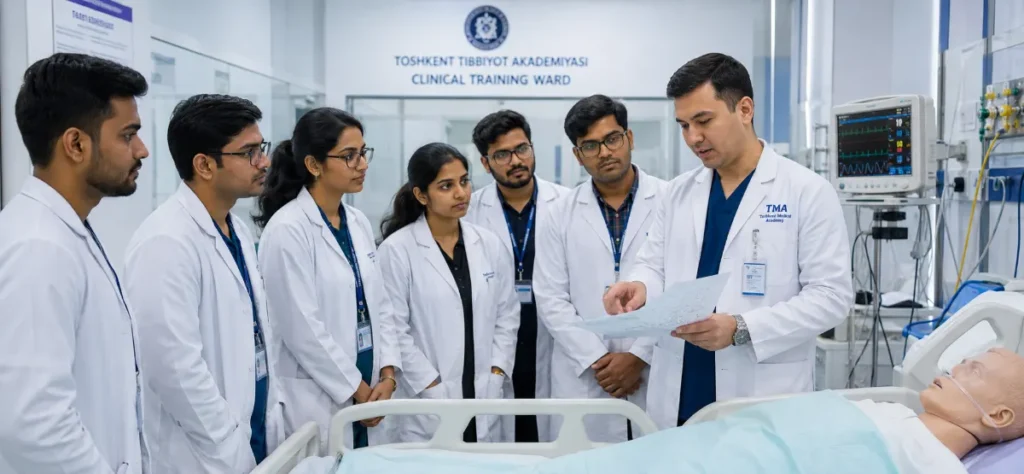
Clinical exposure decides how prepared a student feels once they return to India for licensing exams. So before finalising any MBBS abroad fees, ask which hospitals the university is officially affiliated with, and where those hospitals sit geographically.
A campus located far from its affiliated teaching hospital can mean long daily travel for clinical postings. That travel eats into study time and adds transport costs nobody budgeted for. For general benchmarks on clinical training standards, parents can check the World Health Organization’s resources at WORLD HEALTH ORGANIZATION before making a final call.
- Ask for the exact list of affiliated teaching hospitals
- Confirm the distance between campus and hospital
- Check how many clinical hours are scheduled per week
- Request feedback from a current batch, not just alumni testimonials
Strong clinical exposure during university years makes a real difference once graduates sit for FMGE or NExT. Hands-on experience with real patients builds confidence that classroom study alone cannot fully replace.
Question 10: Does the Internship Structure Match What MBBS Abroad Fees Should Deliver?
The internship year often gets the least attention during counselling, yet it carries real weight later. Ask exactly how the internship is structured at the university before agreeing to any MBBS abroad fees schedule. Some universities run the internship abroad only. Others allow part of it to happen in India, subject to NMC rules current at the time of graduation.
Confirm whether the internship duration meets NMC requirements for practising in India after graduation. Rules do shift from year to year, so a policy that applied to an older batch may not apply to a new admission cycle. A short phone call to a compliance officer at the university, not just the admissions team, usually settles this question clearly.
Keep a printed copy of the internship policy along with your other MBBS abroad fees paperwork. Regulations can be revised mid-course, and having the original terms on record protects your child if a dispute ever comes up later.
Making the Final Call Before You Pay MBBS Abroad Fees
Three buckets matter most once every other question gets answered. University recognition comes first, covering WDOMS, NMC, FMGL and local accreditation together. Complete cost and payment comes second, covering the full 5 to 6 year figure, not a partial quote, plus a written refund policy. Education and clinical training comes third, covering genuine English-medium instruction and a clear internship path.
- Recognition: WDOMS listing, current NMC and FMGL status, local accreditation
- Cost: full multi-year total, direct bank payment, written refund terms
- Training: English medium confirmed through clinical years, affiliated hospitals named, internship structure explained
Parents who walk through all three buckets before releasing MBBS abroad fees rarely face nasty surprises later. Those who skip straight to payment based on excitement alone often do.
Frequently Asked Questions About MBBS Abroad Fees
Uzbekistan tends to run slightly cheaper on both tuition and living expenses, though the gap is usually a few lakh rupees across the full course rather than a dramatic difference. The right choice still depends on the specific university and its recognition status.
Sometimes yes, sometimes no. Always ask the university to confirm in writing whether the quoted fee is tuition only or a bundled package including hostel and food, since this changes the real MBBS abroad total cost significantly.
It can be valid, provided the university is listed in WDOMS and meets current NMC and FMGL requirements, and provided the student later clears the FMGE or NExT licensing exam required for Indian practice.
Six years in Georgia or Uzbekistan typically costs between ₹28 lakh and ₹45 lakh including living expenses, while private management quota seats in India frequently exceed ₹50 lakh to ₹90 lakh for the same duration.
Pay directly into the official university bank account, keep every receipt, and get a signed refund and cancellation policy before the first payment leaves your account. Avoid routing large payments through a personal account.