How Indian Students Can Prepare for NExT While Studying MBBS Abroad
A Focused Guide for Students in Georgia and Uzbekistan
Picture this: you’re in your third year of MBBS in Tbilisi or Tashkent, buried in anatomy notes, and somebody mentions NExT preparation for MBBS Abroad like it’s a problem for some future version of you to deal with. It isn’t. For thousands of Indian students studying in Georgia and Uzbekistan, that one exam back home decides whether five hard years abroad actually turn into a medical license in India. I’ve sat across from enough students to know how this usually goes. Wait until final year to think about it, and you’re setting yourself up for the worst kind of stress, the avoidable kind.
This guide is longer than most blog posts you’ll find on this topic. That’s on purpose. I’d rather give you the full, slightly messy picture than a neat five-point checklist that falls apart the moment your hostel wifi dies during exam week.

Why NExT Preparation for MBBS Abroad Should Begin in Year One
Most Indian students studying MBBS in Georgia or Uzbekistan treat their first two years as pure academic groundwork, something to get through before the real preparation starts. I think that mindset causes more stress than it prevents, and honestly, I say this every single counselling season and students still nod politely and ignore it until year four. NExT preparation for MBBS Abroad works best as a habit that runs alongside your regular coursework, not a project you start after coursework ends.
The earlier you connect what you’re learning on campus to what the NMC actually expects, the less catching up you’ll need later. Less catching up means a calmer final year. That’s really the whole argument in one sentence.
Start with something simple. Map your university syllabus against the Indian medical curriculum. Georgian and Uzbek medical universities cover most of the same core subjects, but the order and depth can differ enough to matter. Get Anatomy, Physiology and Biochemistry solid first, since almost every clinical topic later builds on these three. Keep standard Indian references like BD Chaurasia and Guyton next to your university textbooks, not instead of them. Add a decent Q-bank and a handful of clinical case-based MCQ sets to your weekly routine, and you’ve already built more exam-oriented knowledge than most of your batchmates will have by year three.
NExT Syllabus for MBBS Abroad Students: What Actually Gets Tested
The NExT syllabus for MBBS abroad students isn’t some separate curriculum hiding somewhere you need to hunt for. It mirrors the full MBBS syllabus set by the National Medical Commission, so nothing exotic gets sprung on you at the last minute. Step 1 tests theoretical knowledge across pre-clinical, para-clinical and clinical subjects. Step 2, once it’s implemented, checks clinical and practical competence after your internship.
Here’s what that actually covers, subject by subject:
- Anatomy, Physiology and Biochemistry (pre-clinical foundation)
- Pathology, Pharmacology, Microbiology and Forensic Medicine (para-clinical)
- Medicine, Surgery, Obstetrics and Gynaecology, Paediatrics (major clinical subjects)
- ENT, Ophthalmology, Orthopaedics, Dermatology, Psychiatry and Community Medicine (applied subjects)
- Clinical skills, patient communication and practical procedures for Step 2

Knowing this syllabus early means you can shape your Georgia or Uzbekistan coursework around it instead of scrambling to patch gaps in your final year. That single bit of foresight is what makes NExT preparation for MBBS Abroad feel manageable instead of like a mountain you’re climbing blind.
NExT Study Plan for Indian Medical Students: A Year-by-Year Breakdown
A workable NExT study plan for Indian medical students doesn’t need spreadsheets and colour-coded calendars, though if that’s your thing, go for it, I’m not judging. It needs consistency more than anything else. Spread your preparation across all five years in Georgia or Uzbekistan and a heavy syllabus turns into a set of manageable monthly targets instead of one giant, intimidating pile.
| MBBS Year | Focus Area | NExT-Linked Activity |
|---|---|---|
| Year 1 to 2 | Anatomy, Physiology, Biochemistry | Weekly MCQ practice and flashcards for high-yield facts |
| Year 3 | Pathology, Pharmacology, Microbiology | Case-based Q-banks and short daily revision blocks |
| Year 4 | Medicine, Surgery, OBG, Paediatrics | Clinical correlation notes and subject-wise mock tests |
| Year 5 | Minor subjects, Community Medicine | Full-length mock tests and timed practice papers |
| Internship | Clinical application | Hospital postings and Step 2 style practical revision |
Follow a calendar like this and the workload stays predictable. Skip it, and you’ll likely find yourself trying to cram five years of NExT preparation for MBBS Abroad content into five final-year months. I’ve watched that happen more times than I’d like, and it’s exactly the kind of stress this guide is trying to help you avoid.
Georgia vs Uzbekistan: Does Your NExT Preparation Strategy Actually Change?
I get asked this constantly, so let’s just address it head-on. Short answer: not really. Slightly longer answer: it’s complicated in ways that don’t matter as much as you’d think.
Both Georgian and Uzbek medical universities teach a curriculum that broadly maps onto the MBBS structure back home, and both attract large batches of Indian students, which means both have decent peer networks and study groups already in place. The differences tend to be logistical rather than academic. Tbilisi generally has a more established expat student ecosystem simply because it’s been a popular destination longer. Tashkent’s newer universities are still building that infrastructure in places, though it’s catching up fast.
Neither of these differences changes what NExT actually tests. The exam is set by the National Medical Commission based on the Indian curriculum, not on where you happen to be sitting when you study for it. So if you’re choosing between the two based on which one gives you a leg up on NExT preparation for MBBS Abroad, I’d gently suggest that’s the wrong question. Choose based on cost, climate, campus life, and how far you’re comfortable being from home. The exam prep looks the same either way.

NExT Preparation Strategy for MBBS Students During Clinical Postings
Clinical years change everything, and your NExT preparation strategy for MBBS students should change with them. This is the point where memorising stops being enough and application takes over. NExT preparation for MBBS Abroad finally starts feeling real instead of theoretical, because now you’re standing next to actual patients instead of flashcards.
Hospital postings in Georgia and Uzbekistan give you direct exposure to real symptoms and real diagnostic reasoning, so use it. See a case of anaemia on the ward? Revise the pharmacology of iron supplements that same evening, while it’s still fresh. Assist in a delivery? Go back to your OBG notes that night, not next week.
This habit pays off twice. It cements clinical knowledge faster than passive reading ever could, and it primes you for the practical, scenario-based questions NExT Step 2 is built around. Treat clinical postings and exam preparation as two separate tracks, and you end up doing twice the work for half the benefit.
Balancing MBBS Abroad Life with a Realistic NExT Study Plan for Indian Medical Students
Life in Georgia and Uzbekistan is already full. New language, new food, new friends, a tight university schedule, and somewhere in there, laundry. Bolt exam preparation onto that without a routine, and burnout isn’t a risk, it’s a near certainty. A realistic NExT study plan for Indian medical students has to work with that reality, not against it.
Here’s a weekly split that actually survives contact with real MBBS life:
- Monday to Friday: one focused hour of NExT-aligned revision after classes
- Saturday: one subject-wise mock test or a timed MCQ set
- Sunday: light revision, error log review, and proper rest
This pace holds up. It doesn’t compete with your coursework, and it doesn’t demand weekend-long study marathons that leave you useless on Monday. Small, daily effort compounds faster than the occasional all-nighter ever will.
What Nobody Tells You About Budgeting Time for NExT Preparation Abroad
Here’s the part most guides skip over. That neat one-hour-a-day plan I just gave you? It falls apart constantly, and that’s fine. Clinical rotations run late. Hostel wifi dies right before your mock test. You go home for a wedding and lose ten days. A cousin’s engagement, a festival, a bout of homesickness that hits harder than expected. None of this is a personal failure. It’s just what studying abroad actually looks like.
What I’ve noticed separates students who stay on track from those who don’t isn’t discipline in the dramatic, willpower sense. It’s how quickly they get back to the plan after it breaks. A missed week doesn’t matter much. A missed week that turns into a missed month, because you decided the whole plan was ruined anyway, matters a lot. So if you fall off for a bit, and you will, just pick the plan back up without the guilt spiral. That’s genuinely more useful advice than anything about ideal study hours.
Managing Exam Stress While Keeping NExT Preparation for MBBS Abroad on Track
Stress is part of medical education anywhere in the world, and it gets heavier when you’re also adjusting to a new country. A sound NExT preparation strategy for MBBS students has to include managing that stress, not just covering more subjects.
Protect your sleep, even during exam-heavy weeks. It matters more than one extra hour of revision, and I say that knowing full well most students will ignore it anyway. Get some form of regular movement, a walk counts, since it tends to lower anxiety more reliably than late-night reading ever does. Talk to seniors who’ve already cleared FMGE or are tracking NExT updates themselves. Hearing how they handled it usually shrinks fears that feel enormous in your own head. And try not to measure your pace against classmates constantly, everyone’s starting point is different. A calm, steady approach to NExT preparation for MBBS Abroad beats a stressed, inconsistent one, every time.
How to Prepare for NExT Exam Abroad Using Mock Tests and Active Recall
Rereading the same notes for the fifth time feels productive. It usually isn’t. If you’re genuinely asking how to prepare for NExT exam abroad without burning out halfway through, the honest answer is to switch to active methods, even though they feel harder and less comfortable at first. That discomfort is actually a decent sign you’re learning something.
- Active recall: close the book and write down everything you remember before checking notes again
- Spaced repetition: revisit high-yield topics at increasing intervals instead of cramming once
- Flashcards: keep a running deck of drug names, doses and diagnostic criteria for daily review
- Mock tests: attempt full-length papers every few weeks to build speed and accuracy
- Error logs: maintain a notebook of mistakes from each mock test and revisit it weekly
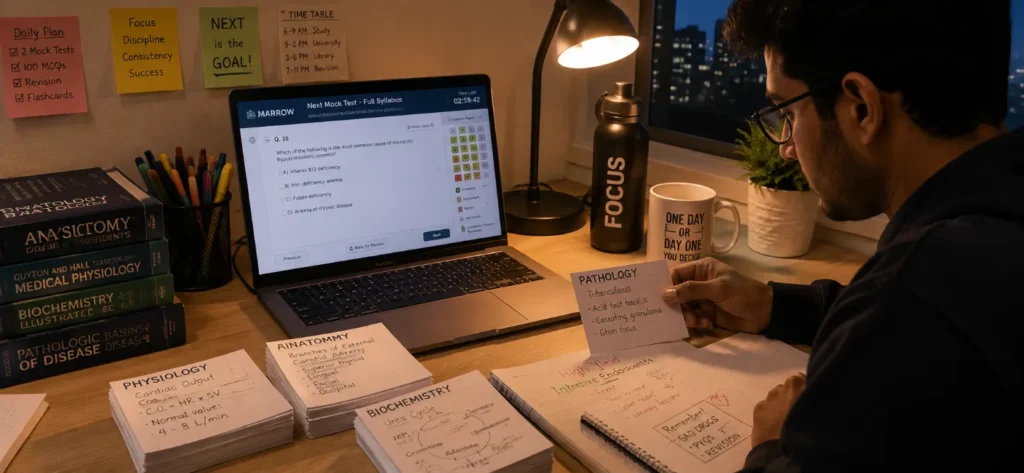
Mock tests deserve extra credit here. They don’t just test what you know, they train your brain to hold focus for three straight hours, which is its own separate skill nobody warns you about.
NExT and FMGE Preparation for MBBS Abroad: What Georgia and Uzbekistan Students Must Know
Here’s something that trips up a lot of students, and I get this question weekly. NExT and FMGE preparation for MBBS abroad aren’t quite the same thing right now, and mixing them up can throw off your entire plan.
As of 2026, the National Medical Commission has pushed the full rollout of NExT further down the road. The commission announced in October 2025 that the exam wouldn’t launch immediately, and that it needed another three to four years of refinement through mock tests and feedback before an official launch. Several reports now point to implementation sometime around 2028 to 2029. Until that actually happens, FMGE remains the exam that foreign medical graduates from Georgia and Uzbekistan genuinely need to clear.
None of this means you should ignore NExT. It just means your preparation should cover both, since one exam existing on paper doesn’t cancel out the one you’ll actually be sitting for.
| Aspect | FMGE (Current) | NExT (Upcoming) |
|---|---|---|
| Status in 2026 | Mandatory for foreign medical graduates | Postponed, expected around 2028 to 2029 |
| Conducted by | National Board of Examinations | National Medical Commission |
| Format | Single-day MCQ screening test | Two-step exam: Step 1 theory, Step 2 clinical |
| Purpose | License to practice in India | License to practice plus PG admission |
| Preparation overlap | Same core MBBS subjects | Same core subjects plus added clinical component |
Because the subject base overlaps almost completely, a solid NExT preparation for MBBS Abroad routine carries straight over into FMGE readiness. You’re not choosing between the two exams. You’re building one foundation that happens to cover both.
Common Mistakes That Delay NExT Exam Preparation for Indian Students Abroad
Even genuinely hardworking students slow themselves down without noticing. Watch for these patterns, because they quietly derail NExT exam preparation for Indian students abroad more often than any single hard subject does.
- Delaying revision until final year and treating early years as exam-free
- Relying only on university lecture notes without cross-checking Indian textbooks
- Skipping mock tests because they feel uncomfortable or time-consuming
- Studying subjects in isolation instead of linking them to clinical cases
- Ignoring official NMC updates and assuming old exam patterns still apply
Fix even two or three of these habits early, and you’ll save yourself months of unnecessary stress later.
My Honest Take on Coaching vs Self-Study for NExT Preparation
I work at an organisation that offers coaching, so take this with whatever grain of salt feels appropriate. But I’ll say it plainly anyway: coaching isn’t the right fit for every student, and I’d rather tell you that upfront than pretend otherwise.
If you’re naturally structured, if you can sit down and actually follow a study plan without someone checking in on you, self-study plus good Q-banks and mock tests will probably get you where you need to go. Plenty of students manage this perfectly well on their own. Where guided support tends to help more is when you’re the kind of student who knows what to do but keeps not doing it, or when you’re so deep into clinical years that you genuinely don’t have the bandwidth to plan your own NExT preparation strategy for MBBS students on top of everything else. There’s no shame in either category, and honestly, most students I’ve met are somewhere in between.
NExT Preparation Tips for Foreign Medical Graduates: Tools and Support
The best NExT preparation tips for foreign medical graduates usually come down to something unglamorous: using the right tools at the right stage, instead of hoarding every resource you find online, most of which you’ll never open again.
- Standard Indian textbooks such as Chaurasia, Guyton and Robbins
- A reliable Q-bank with previous-pattern and predicted questions
- A study group within your Georgia or Uzbekistan campus for weekly discussions
- One dedicated mock test platform used consistently, rather than five
If you’d rather have structured guidance than piece all of this together alone, personalised NExT and FMGE coaching can shorten the learning curve considerably, especially when it runs alongside your regular MBBS coursework in Georgia or Uzbekistan. It’s also worth checking the official National Medical Commission website every so often for regulation updates, and the National Board of Examinations portal for the current FMGE exam pattern.

Building a Support Network From Abroad for NExT Preparation
Nobody really talks about this part, but the students who handle NExT preparation for MBBS Abroad best usually aren’t doing it alone, even if the studying itself happens solo. Seniors who’ve already sat FMGE, batchmates going through the same syllabus, a family member back home who checks in without turning it into pressure. All of that matters more than people admit.
If you don’t already have a study group on campus, start one. It doesn’t need to be formal. A weekly hour where three or four of you compare notes on a subject does more for retention than most people expect, partly because explaining something to someone else is one of the fastest ways to find the gaps in your own understanding. And when the syllabus feels endless, which it will, having other people in the same boat makes it feel less like a solo grind and more like something you’re getting through together.
Staying Updated on NMC Guidelines for NExT Preparation While Studying MBBS Abroad
Regulations around this exam have shifted more than once already, and they’ll probably shift again before anything is finalised. NExT preparation while studying MBBS abroad has to include the habit of checking for updates, because books alone won’t tell you when the goalposts move.
Set yourself a monthly reminder to check NMC circulars. Follow education portals that actually track policy changes for foreign medical graduates, not ones that just repost old news with new dates. Join genuine student communities in Georgia and Uzbekistan, where verified updates tend to travel fast. Skip the forwarded messages from someone’s cousin’s friend, misinformation about exam dates spreads faster than real updates ever do, and it causes panic for no reason.
How Annamalayar Educational Trust Strengthens Your NExT Preparation Strategy for MBBS Students
Studying MBBS abroad already means adjusting to a new country, a new language environment, and a demanding curriculum, all at once. Piling exam preparation on top of that without any guidance is exactly where a lot of students start to struggle.
That’s the gap structured support is meant to close. Guidance at every stage of NExT preparation for MBBS Abroad makes a real, measurable difference, not just a motivational one. From choosing the right university in Georgia or Uzbekistan to staying on track with NExT and FMGE preparation for MBBS abroad across all five years, having an experienced team in your corner changes the outcome. Visit Annamalayar Educational Trust to see how students are guided from admission all the way through to licensing exams, with consistent academic tracking the whole way.
A clear NExT preparation strategy for MBBS students doesn’t get built in the final year, under pressure, at two in the morning. It gets built one semester at a time, starting now, while you still have the luxury of time on your side.
Key Takeaways for NExT Preparation for MBBS Abroad
Five years abroad go by faster than you’d expect. Before you head back to your notes and your next hospital posting, here’s the short version.
- Start NExT preparation for MBBS Abroad in year one, not in the final semester
- Align university coursework in Georgia or Uzbekistan with the NMC-set syllabus
- Use active recall, spaced repetition and regular mock tests instead of passive reading
- Track both FMGE and NExT, since the subject base overlaps almost completely
- Keep a sustainable weekly routine rather than occasional long study marathons
- Check NMC updates monthly so regulation changes never catch you off guard
None of this demands a dramatic overhaul of how you already study. It just asks you to start earlier and stay consistent, semester after semester.
Frequently Asked Questions on NExT Preparation for MBBS Abroad
Start in year one, since small weekly habits across five years beat months of last-minute cramming.
Eventually yes, but since NExT is postponed to around 2028 to 2029, FMGE is the exam you actually need to clear right now.
FMGE is a single-day MCQ test running now, while NExT will be a two-step theory-and-clinical exam once it launches.
Not entirely, since Indian exam-pattern practice through Q-banks and mock tests covers what university coursework alone leaves out.
One to two focused hours daily is enough, as long as you stay consistent and add weekend mock tests.