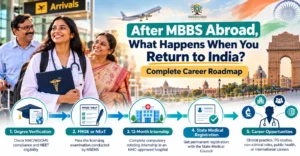
NEET Requirement for MBBS Abroad: Why NEET Qualification Is Mandatory for Return Practice

Every year, we speak with hundreds of students who are seriously considering MBBS abroad in Georgia, Uzbekistan, Russia, Kazakhstan, and the Philippines. The fees are affordable, the seats are available, and the admission process often feels much simpler than the highly competitive medical admission process in India.
However, one important factor that many students and parents overlook is the NEET Requirement for MBBS Abroad. Just because you’re planning to study medicine overseas doesn’t mean NEET stops being important.
The NEET Requirement for MBBS Abroad is a mandatory regulation for Indian students who wish to return and practise medicine in India after completing their degree. Skipping NEET or failing to meet the qualifying cutoff can create serious obstacles when it comes to licensing and registration back home. In this guide, we’ll explain what this requirement means, why it exists, and what every aspiring medical student should know before choosing an international medical university.
What Is the NMC Rule? – NEET Requirement for MBBS Abroad
The National Medical Commission (NMC) is the body that regulates medical education in India. If you want to work as a doctor in India after finishing your MBBS abroad, the NMC decides whether you’re eligible to do that.
This rule is non-negotiable: you must have qualified NEET-UG before taking admission to a foreign medical university.
Neither a high score nor a top rank is needed. Just qualification clearing the cutoff for your category. For the General category, that’s the 50th percentile. For SC/ST/OBC, it’s the 40th percentile.
If you don’t appear for NEET Exam, or if you didn’t meet the qualifying percentile, then under Indian law you are not eligible to sit for the FMGE Exam after graduation. And without FMGE, you can’t get a medical licence in India.
And the bottom line is it’s one of the first things we clarify with every family while we counsel.
Why Did This Rule Come In?
Before 2018, students can study MBBS anywhere abroad and come back and take the Foreign Medical Graduate Examination (FMGE). There was no NEET requirement attached. The result? Students who hadn’t cleared basic science thresholds were getting degrees from foreign universities and returning to India to practise.
The NMC (then MCI) decided this needed to be fixed. From the 2018-19 admission batch onward, NEET qualification became mandatory for any Indian student pursuing MBBS abroad who wanted to practise in India after graduation.
The logic is straightforward. NEET tests whether a student has the foundational knowledge of biology, chemistry, physics to handle medical education. If someone can’t clear even the basic qualifying cutoff, there’s a reasonable concern about preparedness.
We’re not saying NEET is a perfect system. Plenty of genuinely bright students have a complicated relationship with competitive exams. But from the NMC’s point of view, NEET is the filter India uses to maintain a minimum standard and students going abroad aren’t exempt from it.

The FMGE-to-NExT Shift, What We Think You Should Know – NEET Requirement for MBBS Abroad
For a long time, the exam foreign medical graduates had to clear before practising in India was called FMGE (Foreign Medical Graduate Examination). It had a tough reputation; pass rates historically hovered around 15-25% on average, though students from better universities did significantly better.
Now, India is transitioning to NExT the National Exit Test. NExT applies to both Indian MBBS graduates and foreign medical graduates equally. So when a student comes back from Tbilisi or Tashkent, they’ll sit for the same exit exam as their peers who studied at AIIMS or a private college in Chennai.
This matters. Here’s what it means practically:
- The playing field is more level than it used to be
- The exam tests clinical reasoning, not just rote memory
- Students who studied seriously abroad can genuinely compete
But it also means and we want to be direct about this that your NEET qualification on the way in determines your eligibility to sit for NExT on the way out.
Does NEET Score Affect University Admissions Abroad?
Foreign universities don’t use your NEET score to decide admission. Most admit you based on your Class 12 PCB marks and whether you’ve cleared NEET (yes/no). Some don’t even verify this themselves but that’s the university’s process. India’s rules are separate.
What NMC checks is whether you qualified NEET before you enrolled. If you joined a university in September 2024, NMC expects your NEET result from May 2024 to show the qualifying percentile.
Here’s the scenario we’ve seen play out more than once: a student secures admission abroad, completes 6 years, gets their degree, comes back to India and then finds out they can’t even register for NExT because they didn’t qualify NEET before joining. Six years. A full degree. Doors closed at the last step.
We don’t bring this up to alarm you. We bring it up because it’s preventable and because fixing it after the fact is not really possible- NEET Requirement for MBBS Abroad
The Eligibility Checklist NMC Actually Uses
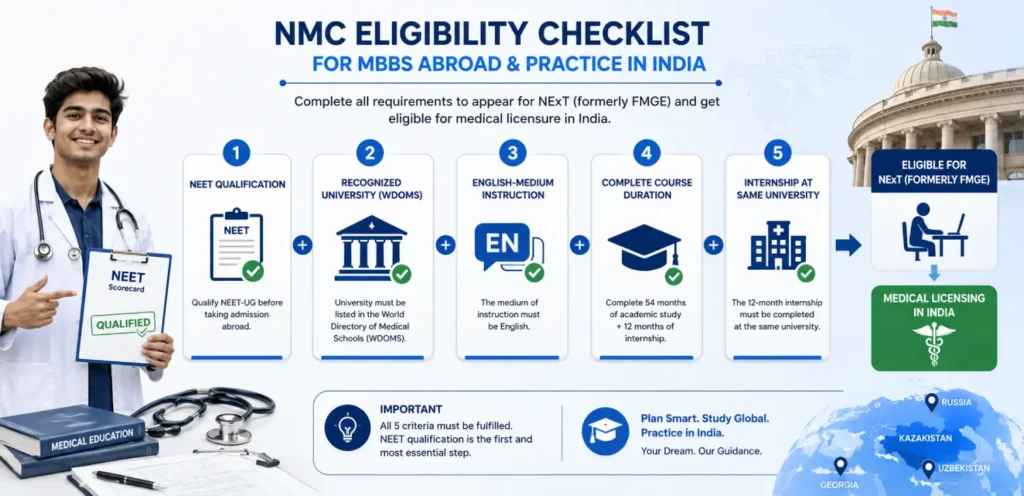
When a foreign medical graduate applies to appear for NExT in India, NMC verifies five things:
- Did the student qualify NEET-UG before taking admission abroad?
- Is the foreign university recognized by NMC and listed in the World Directory of Medical Schools (WDOMS)?
- Was the medium of instruction English?
- Did the student complete the full course 54 months of academic study + 12 months of internship?
- Was the internship completed at the same university?
All five boxes need to be ticked. NEET is box number one.
When families come to us, one of the first things we do is walk through this checklist together because catching a gap at the planning stage costs nothing. Catching it six years later costs everything.
What About Students Who Want to Practise Outside India?
This is where things get genuinely interesting and where we have a lot of honest conversations with students.
The NEET requirement only applies if you want to return to India and practise here. If your plan is to build your career in the US, UK, Canada, or Australia NEET is not part of those licensing pathways.
For the US, you’d sit for USMLE. For the UK, it’s PLAB or UKMLA. For Australia, it’s AMC. None of these require NEET.
So technically, a student who completes MBBS in Georgia, does well in USMLE, and builds a career in the States doesn’t need to worry about NEET at all as long as their university is listed in WDOMS.
But here’s the honest reality we share: most Indian students abroad do want to come back home at some point. Family roots, the sheer scale of healthcare demand in India the pull is real. Planning your MBBS abroad without NEET qualification is a bit like booking a one-way ticket assuming you’ll never want to return. Maybe you won’t. But in our experience, most students do – NEET Requirement for MBBS Abroad
The Minimum Qualifying Percentile: What You Actually Need – NEET Requirement for MBBS Abroad
We want to make this concrete, because there’s a lot of confusion around “NEET score vs NEET percentile.”
You don’t need a high score to be eligible for MBBS abroad. You need the qualifying percentile. Here’s what that looks like:
| Category | Minimum Qualifying Percentile | Approximate Marks (out of 720) |
| General | 50th percentile | 137+ |
| OBC / SC / ST | 40th percentile | 107+ |
| PwD (General) | 45th percentile | 122+ |
These thresholds shift slightly year to year depending on how the paper goes. But the point is this is not a high bar for a student who has put in serious preparation.
If a student scored 200 or 250 in NEET and didn’t get a government seat in India, they’ve almost certainly cleared the qualifying percentile. They can go abroad and come back with full eligibility intact.
If a student scored below the qualifying percentile or didn’t appear at all that needs to be resolved before any admission abroad happens. We always advise families to sort this out first, not after.
Avoidable Common Mistakes We See Every Year – NEET Requirement for MBBS Abroad
After working with students across multiple NEET cycles, we’ve noticed the same missteps come up again and again. These are the ones that actually cost students their future options:
Not appearing for NEET at all. Some students hear “MBBS abroad doesn’t require NEET for admission” and take that to mean NEET doesn’t apply to them. It applies just at a different point in the process. You need NEET qualification before joining a foreign university.
Joining a university before NEET results are out. Some universities run early intake processes. Students rush to secure a seat before their scorecard is even available. This creates a documentation gap that’s very difficult to fix later.
Picking a university not listed in WDOMS or NMC’s approved list. NEET qualification alone isn’t enough if your university doesn’t have proper recognition. Both conditions must be met and we always verify this with families before they commit.
Assuming “WHO recognized” equals “NMC approved.” These are separate bodies. A university can be WHO-listed but not NMC-approved. For Indian students, NMC approval is the one that matters for practising in India.
Losing documentation over six years. When you apply for NExT registration, you’ll need proof of NEET qualification. Scorecard, admit card keep them. It sounds obvious, but six years is a long time and things do get lost.
Does NEET Preparation Help with NExT?
Yes, it helps indirectly
Students who seriously prepared for NEET tend to do better in FMGE and NExT. The subject overlap is significant. NEET tests biology, physics, and chemistry at the Class 12 level. NExT tests clinical knowledge built on exactly that foundation.
A student who genuinely understood physiology, biochemistry, and anatomy at the NEET stage enters their MBBS abroad with a real head start. They pick up concepts faster. They handle pre-clinical subjects with more confidence.
We’re not claiming NEET prep directly translates to NExT success clinical medicine is a different kind of exam altogether. But in the students we’ve seen come back and sit for FMGE, the ones who struggled with core NEET concepts almost always struggled with the same material abroad. The foundation shows up later, one way or the other – NEET Requirement for MBBS Abroad
What the NExT Exam Actually Tests
Since NExT is replacing FMGE, it’s worth understanding what you’re preparing for after graduation.
NExT has two parts:
- NExT Step 1: Written theory exam covering 19 subjects. Tests clinical reasoning and application not just recall.
- NExT Step 2: Practical and clinical skills assessment conducted at medical colleges in India.
Both steps need to be cleared for a full medical licence. Step 1 alone qualifies you for a provisional licence and PG entrance.
The shift to NExT is actually good news for students from strong foreign universities. Real clinical exposure during MBBS hospital rotations, patient interaction, hands-on learning directly prepares you for a skills-based exit exam. This is one reason we pay close attention to the quality of clinical training when we recommend universities in Georgia or Uzbekistan. The classroom marks matter, but what happens in the hospital years matters just as much.
And yet none of this counts if the NEET qualification wasn’t in place before you joined- NEET Requirement for MBBS Abroad
A Note for Parents Reading This
If your child is in Class 11 or 12 and MBBS abroad is on the table please don’t treat NEET as optional.
Not because they need a top score. Not because they’re competing for government seats in India. But because qualifying NEET keeps all their options open. Six years is a long time. Plans change. Kids who are certain they’ll build their career abroad sometimes come home wanting to practise here.
A basic NEET qualification not a rank, just the qualifying percentile is inexpensive insurance against a very expensive problem later. We’ve seen families realise this too late. We’d rather be the ones who make sure you’re not in that position – NEET Requirement for MBBS Abroad

How We at Annamalayar Educational Trust Can Help– NEET Requirement for MBBS Abroad
We work with students who are seriously planning their MBBS abroad, not just searching for the cheapest option and hoping it works out.
What we do is help you see the full picture before you commit: NEET eligibility status, university shortlisting, NMC recognition verification, documentation planning, and a clear understanding of what the path home looks like after graduation.
Whether you’re just starting to think about NEET prep or you’re already comparing universities in Georgia, Uzbekistan, Russia, and beyond speak to us before you finalise anything. The decisions made now have consequences that play out across the next decade. We’d rather you make them with complete information than patch problems six years from now when the options are limited.
Reach out to the Annamalayar Educational Trust team today. One honest conversation now is worth a lot more than regrets later.
Frequently Asked Questions – NEET Requirement for MBBS Abroad
Yes. Indian students must qualify NEET before enrolling in a foreign medical university if they plan to practise medicine in India after graduation.
No. Without qualifying NEET before admission, you may not be eligible for licensing examinations required to practise medicine in India.
Most foreign universities only require NEET qualification and Class 12 PCB eligibility. A very high NEET score is usually not mandatory.
Countries such as Georgia, Uzbekistan, Russia, Kazakhstan, and the Philippines are popular due to affordable tuition fees and internationally recognized medical programs.
Students should check whether the university is listed in the World Directory of Medical Schools (WDOMS) and meets current NMC guidelines before applying.