NMC Guidelines for MBBS Abroad 2026: What Every Indian Student Must Know
Every year, Indian families spend lakhs sending their children to study medicine abroad. Some of those students come back with a solid degree and a clear path to practice. Others come back stuck — degree in hand, no recognition, no license, no way forward. The difference between those two outcomes almost always comes down to one thing: whether they followed the NMC guidelines for MBBS abroad from the very beginning.
This guide breaks down exactly what those rules are, what has changed going into 2026, and what you need to do at each stage to protect your investment and your career.
Why the NMC Sets These Rules in the First Place
The National Medical Commission replaced the older Medical Council of India and took over the job of regulating medical education across the country. Its job includes deciding which foreign degrees get recognised in India and which do not.
The logic is simple. A doctor practising in India needs to meet a certain standard. Whether that doctor trained in Chennai or Kyiv should not matter, as long as their education was rigorous enough. Think of it as a quality filter. The NMC wants to ensure that every graduate who treats patients in India has gone through a program rigorous enough to deserve that responsibility.
There is no grey area here. Either you meet every requirement or you do not. Either you meet every criterion or you do not.
Who Is Actually Eligible to Study MBBS Abroad Under NMC Rules?
Most families jump straight into shortlisting universities and comparing costs. Stop. Before the country, before the university, before the fees — the starting point is whether you personally meet the basic requirements. The NMC eligibility criteria for MBBS abroad are clear:
- Age is the first box to tick. Students must have turned 17 by the 31st of December in the year they are seeking admission.
- Physics, Chemistry, and Biology need to be core subjects in your Class 12 curriculum. Having them as optional extras or additional papers does not count.
- You must have qualified NEET-UG before applying for admission. A valid score is required. There is no minimum cutoff specified for studying abroad, but the exam is compulsory.
- You must obtain an NMC Eligibility Certificate before you formally enroll in any foreign university.
That last point is the one most students are missing. The Eligibility Certificate is not something you get after starting your course. You apply for it before admission, using your NEET scorecard, Class 12 certificates, passport, and a provisional admission letter from the university.
The consequences rarely hit immediately. They tend to surface much later, at the worst possible moment. By the time most students realize the Eligibility Certificate is missing, they have already completed their degree and are standing at the NExT registration door with nowhere to go.
Annamalayar Education Trust helps students navigate the Eligibility Certificate process from start to finish, so nothing falls through the cracks.
How to Find an NMC Recognised University Abroad – NMC Guidelines for MBBS Abroad
Not every university that markets itself to Indian students is actually recognised. It happens far more often than most people realize, and it is almost always avoidable.
The NMC uses two key references to determine which universities are acceptable:
World Directory of Medical Schools (WDOMS): Maintained by FAIMER and WFME, this is the global directory of accredited medical schools. Start here. Head to wdoms.org, look up the university by name or country, and make sure it shows up as active and currently listed.
A WDOMS listing is necessary but not sufficient: The NMC runs its own compliance checks and can drop a university from recognition even if it still appears in the global directory. Always cross-reference both sources independently.
Popularity among Indian students means nothing when it comes to NMC recognition. A packed campus and good reviews do not make a university compliant. Agent brochures and YouTube testimonials are not verification. Do the two-step check yourself.
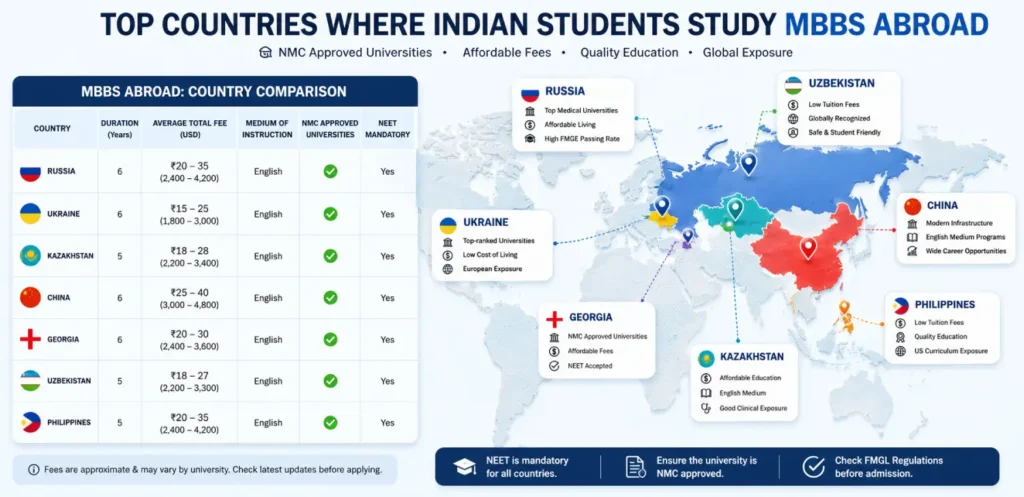
Countries Where Indian Students Commonly Study MBBS
| Country | Duration | Medium | Key Note |
|---|---|---|---|
| Russia | 6 years | English/Russian | Verify each university individually |
| Ukraine | 6 years | English | Check current status post-conflict |
| China | 6 years | English | Bilingual concerns; verify carefully |
| Philippines | 5.5 years | English | Strong clinical training |
| Kazakhstan | 6 years | English | Verify WDOMS status |
| Kyrgyzstan | 6 years | English | Cost-effective; check NMC listing |
| Georgia | 6 years | English | European curriculum standards |
| Bangladesh | 5 years | English | Nearest option; strong clinicals |
The Core Academic Requirements You Cannot Ignore
Getting into a recognised university is only the first part. The structure of the program itself must meet specific NMC standards.
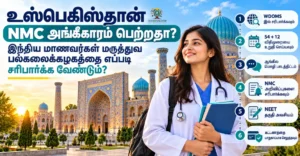
54 months of academic training. The medical program must include at least 54 months of actual study — lectures, labs, and clinical postings — not counting the internship.
12-month internship at the same institution. After the academic period, you complete a full-year rotating internship. It must be done at the same university or its directly affiliated hospitals. An internship at a separate hospital, even a good one will not count.
Full English instruction. Every part of the program — lectures, labs, clinical postings — must be delivered in English. No exceptions. Bilingual programs where clinical training shifts to the local language are not acceptable. Online-only programs are similarly not recognised.
Your degree must make you license-eligible in the country where you studied. If local graduates of that university cannot practice there, your Indian recognition will not hold either. This is a requirement many students overlook. The NMC requires that your degree qualifies you to practice medicine in the country where you studied it. If the university’s own graduates cannot get a license in that country, your Indian recognition is off the table too.
If you are unsure whether a specific program meets these criteria, our counselors can walk you through a detailed check before you commit at Annamalayar Educational Trust – NMC Guidelines for MBBS Abroad
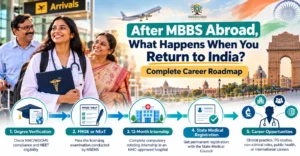
What Happens After You Return: The NExT Exam
You finish your degree, complete your internship, and return to India. The path to practice does not end there. Every foreign medical graduate must pass the National Exit Test (NExT) to obtain a license.
NExT has two steps:
- Step 1: Theory-based examination covering core medical subjects.
- Step 2: Clinical and practical assessment.
Both are mandatory. There are no exemptions based on marks or university reputation. A student who scored top of their class abroad still has to clear NExT.
There is one more possibility. If the NMC does not recognise your overseas internship, you may be asked to complete an additional internship in India before you can register to practice. This happens on a case-by-case basis and depends on whether your overseas internship met the required clinical rotation structure.
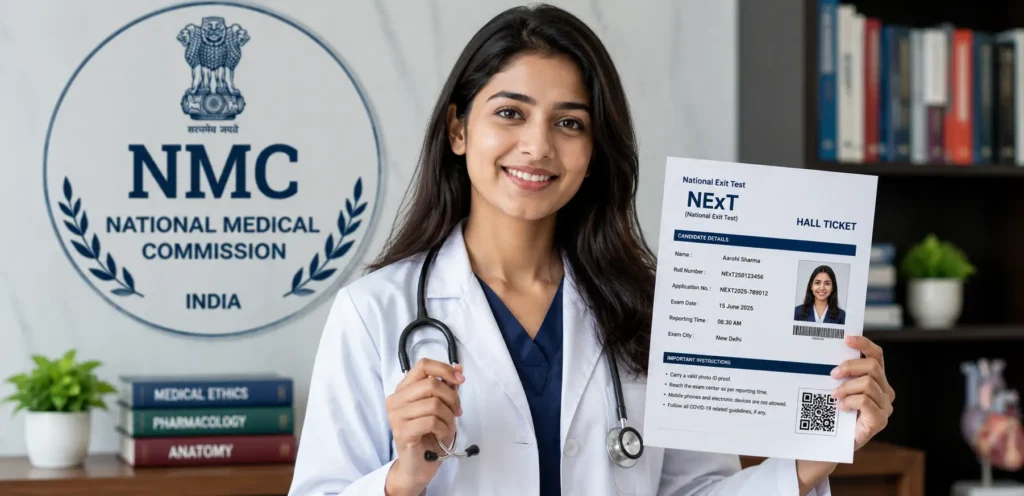
For updated schedules and syllabi, check the NMC’s official portal directly. The framework is still being refined and notifications are issued periodically.
Mistakes That Cost Students Years of Their Life – NMC Guidelines for MBBS Abroad
These are not hypothetical. These are the patterns that show up repeatedly among students who end up in trouble.
Choosing a university based on cost alone. Cheap tuition is appealing. But universities that charge very little often have weak clinical infrastructure, which directly affects whether the program meets NMC standards.
Skipping the Eligibility Certificate. Many students assume they can apply for it later. They cannot. The certificate must be obtained before enrollment, and without it, NExT registration becomes complicated.
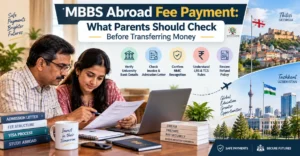
Trusting the agent over independent verification. Education agents have a financial incentive to fill seats. Verify universities using WDOMS and the NMC portal yourself, not through a third party.
Not tracking regulation updates. The rules do change. A university that was recognised three years ago may have been removed. Always verify before you commit money.
Completing the internship at the wrong hospital. Even well-intentioned decisions like doing the internship at a major city hospital instead of the affiliated institution can cause recognition problems.

The FMGL Regulations: The Legal Framework Behind All of This
The Foreign Medical Graduate Licentiate (FMGL) Regulations are the actual legal document that governs recognition for students who studied abroad. Everything discussed in this guide flows from that framework.
Under the FMGL rules, to get a medical license in India a foreign graduate must:
- Hold a degree from an NMC recognised foreign university.
- Have obtained the NMC Eligibility Certificate before admission.
- Have completed 54 months of academics and a 12-month internship at the same institution.
- Pass both steps of NExT.
All four conditions must be met. Not three. Not three and a half. All four. That is why planning from the very beginning matters so much.
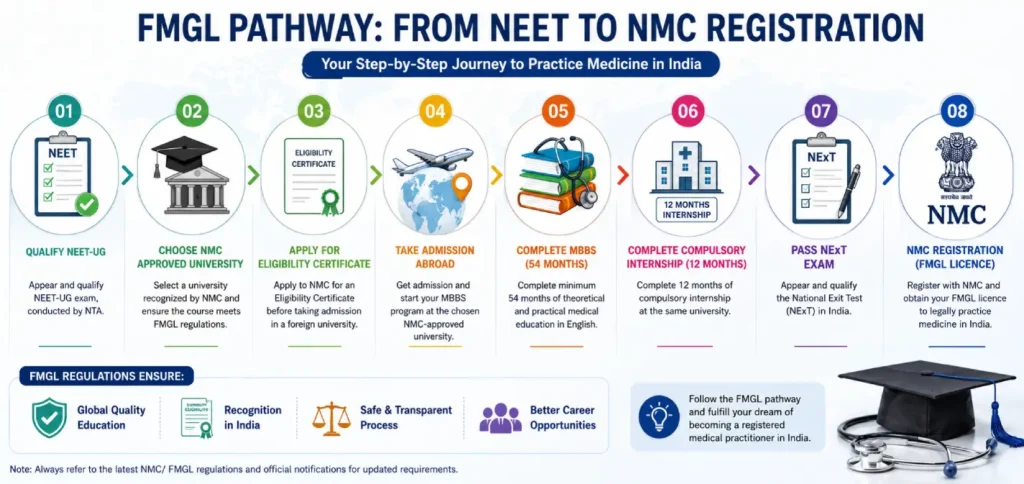
The full FMGL Regulations are available on the NMC portal. Reading them directly, rather than relying on summaries, is always worth the effort.
Is Studying MBBS Abroad Still Worth It?
Honestly? For the right student, yes.
Countries like the Philippines, Georgia, and Russia offer genuinely solid medical education. The cost is significantly lower than Indian private colleges. For a student who could not secure a government seat and does not want to pay 80 to 100 lakhs for a private Indian MBBS, going abroad is a real option.
But it only works when done properly. The NExT exam now means that every doctor practising in India, wherever they studied, clears the same bar. That is fair. It also means there is no shortcut through foreign medical education. The degree has to be solid, and the compliance has to be complete.
If you are serious about medicine and willing to do it right, the path is there. If you are hoping to sidestep NEET or avoid competitive exams, the current system will not accommodate that.
Frequently Asked Questions – NMC Guidelines for MBBS Abroad
1. Is NEET compulsory for MBBS abroad? Yes. You must qualify NEET-UG before applying to any foreign medical university. There is no exemption. Students who enrol without a valid NEET score will not be eligible to appear for NExT in India.
2. How do I verify if a university is NMC recognised? Check the World Directory of Medical Schools first. Then cross-reference with the NMC’s official portal. Both checks are necessary — WDOMS alone is not enough.
3. Can I do my internship in India instead of abroad? No, not as the primary internship. The 12-month internship must be completed at the same institution where you did your degree, or its affiliated hospitals. You may be required to do an additional Indian internship later if the NMC does not recognise the overseas one.
4. What if I enrolled without getting the NMC Eligibility Certificate? This is a serious issue that can affect your ability to register for NExT. Consult a medical education legal expert immediately if you are in this situation. Do not wait until you return to India.
5. When should I appear for NExT? After completing your degree and internship abroad. The exam has two steps — theory and clinical. Both are mandatory for all foreign medical graduates, regardless of academic performance. Check the NMC portal for current scheduling and eligibility details.
This article is for informational purposes only. NMC regulations are updated periodically. Always refer to the official NMC portal at www.nmc.org.in before making any decisions about studying MBBS abroad.