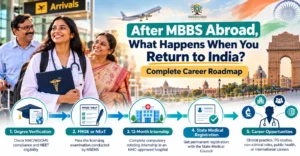
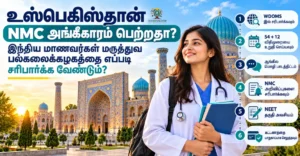
Requirements to Study MBBS Abroad for Indian Students: Complete 2026 Eligibility Guide
You cleared NEET. Your Class 12 marks are decent. Now every relative has an opinion about which country to pick, every agent has a guaranteed seat, and every university brochure sounds identical. What nobody is telling you clearly is this: the MBBS abroad requirements set by India’s National Medical Commission are very specific. Miss even one, and your foreign degree will not get you a licence to practise back home. That is the real risk. This guide cuts through the noise and tells you exactly what you need, specifically for Georgia and Uzbekistan, the two countries Indian students are choosing the most right now.
Why Indian Students Are Choosing Georgia and Uzbekistan for MBBS
Around 20 lakh students sit for NEET every year. Government MBBS seats in India? Roughly one lakh. The gap is brutal. So studying medicine abroad is no longer the backup option it used to be. It has become a practical first choice for a lot of families.
Georgia sits right at the edge of Europe and Asia. English-medium programs, WHO-recognised universities, relatively low fees, and a campus life that Indian students actually enjoy. Uzbekistan, meanwhile, has transformed its medical education sector fast. Modern labs, NMC-compliant course structures, direct flights from most Indian cities, and annual fees that fall between USD 3,500 and 5,500 at reputable institutions. Both countries check the boxes. But only if you know which boxes matter.

Core MBBS Abroad Eligibility Criteria You Must Meet
Age
You must be at least 17 years old on or before 31st December of your application year. No upper age limit exists under NMC guidelines as of 2026.
Class 12 Marks in PCB
This is where a lot of students get surprised. The MBBS abroad eligibility threshold is 50% aggregate in Physics, Chemistry, and Biology for general category students. Reserved category students (SC, ST, OBC) need 40%. English must also be one of your Class 12 subjects. Not optional.
NEET Is Non-Negotiable
Many students assume that if the foreign university itself does not ask for NEET, they can skip it. That is wrong. The NMC has been clear since 2018: if you want to practise medicine in India after your study MBBS abroad degree, you need a valid NEET-UG score before you even enroll. No NEET means no FMGE or NExT eligibility later. There is no minimum NEET score cutoff for abroad admissions, but the score must exist and be valid.
MBBS Abroad Eligibility at a Glance
| Criterion | General Category | Reserved (SC/ST/OBC) |
|---|---|---|
| Minimum age | 17 by 31st Dec | 17 by 31st Dec |
| PCB aggregate, Class 12 | 50% | 40% |
| NEET-UG score | Mandatory | Mandatory |
| English in Class 12 | Mandatory | Mandatory |
| NMC-approved university | Required | Required |
| FMGE / NExT after graduation | Must qualify | Must qualify |
NMC Compliance Rules That Protect Your Future Licence
Picking a university based on fees alone is how students end up with a degree they cannot use. The NMC has laid down specific MBBS abroad requirements that the program itself must satisfy:
- 54 months minimum of academic coursework. Not including internship.
- 12-month internship completed in the same country as your university.
- English medium of instruction throughout the program.
- WDOMS listing — the university must appear in the World Directory of Medical Schools.
- NMC recognition — always verify on the official NMC website, not an agent’s word.
Both Georgia and Uzbekistan have universities that satisfy every one of these rules. But not every university inside those countries qualifies. Some private colleges in both nations have either lost NMC recognition or were never listed to begin with. Verify your specific institution. Annamalayar Education maintains a verified list of NMC-approved universities in both countries if you want a reliable starting point.
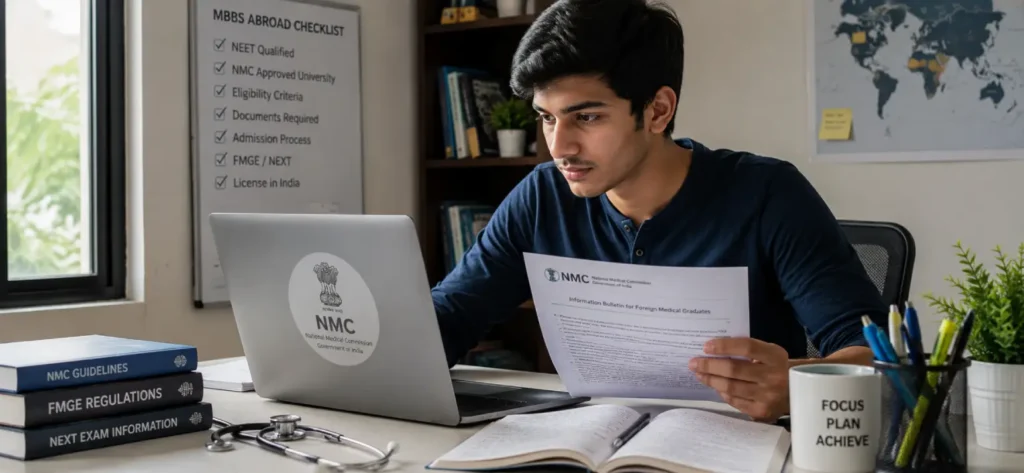
MBBS in Georgia: What the Requirements Look Like on the Ground
Georgia is not just geographically convenient. The academic quality at institutions like Tbilisi State Medical University and David Tvildiani Medical University has a genuine track record. Clinical exposure starts early. The curriculum follows European standards fairly closely, which matters if you ever want to explore opportunities outside India.
Here is what MBBS abroad requirements look like specifically for Georgia:
- PCB score: 50% for general, 40% for reserved categories.
- NEET: Valid scorecard required at the time of application.
- University: Must be NMC-approved and listed in WDOMS.
- Course: 54 months academics plus 12 months internship in Georgia itself.
- Medium: English throughout. Some elective rotations may involve Georgian, but core teaching is English.
- After graduation: Clear FMGE or NExT to get your Indian medical licence.
One more thing worth knowing: Georgia’s cost of living is low compared to Europe but slightly higher than Uzbekistan. Monthly expenses typically run between USD 350 and 500 for most Indian students, including accommodation and food. Explore MBBS abroad options including Georgia to compare specific universities before applying.

MBBS in Uzbekistan: Eligibility and What Makes It Work for Indian Students
Uzbekistan has moved fast. Since around 2016, the government has pushed heavy investment into medical education infrastructure. Tashkent Medical Academy, Samarkand State Medical University, Andijan State Medical Institute — these are not unknown names in Indian MBBS circles anymore.
The MBBS Abroad Requirements eligibility criteria for Uzbekistan match NMC’s standard requirements. But the on-ground realities make it particularly suited for Indian students:
- Fees between USD 3,500 and 5,500 per year, depending on the university.
- English-medium programs with simulation labs that are actually functional.
- Climate and food culture that Indian students tend to adjust to faster than Europe.
- Direct flights from Delhi, Mumbai, Chennai, and other major Indian cities to Tashkent.
- Strict adherence to NMC’s 54-month plus 12-month internship structure at top institutions.
For Uzbekistan specifically, the student visa process also asks for a medical fitness certificate and a police clearance certificate early in the process. These take time to get. If you are targeting Uzbekistan for the September intake, start both documents no later than April.
MBBS Abroad Documents Checklist for Indian Students – MBBS Abroad Requirements
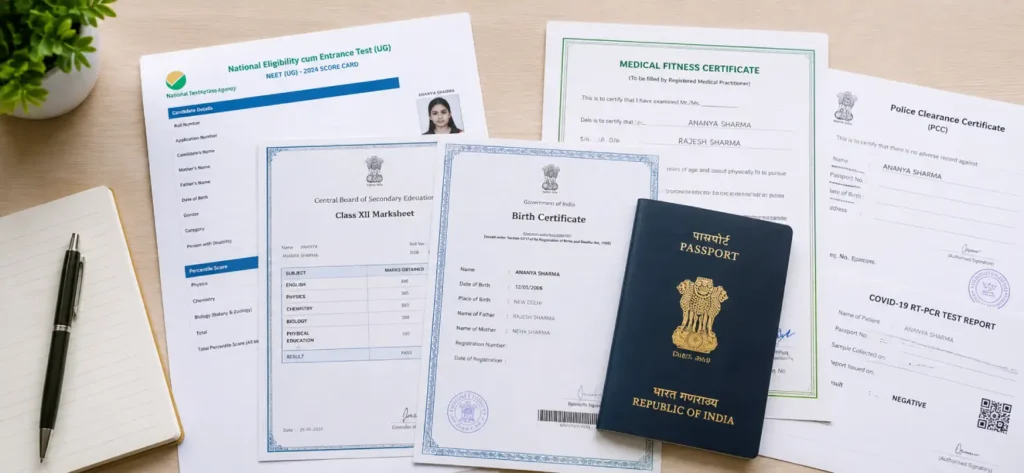
This is where students lose weeks. Get your MBBS abroad documents ready before applications open. Attestation takes time. Apostille processing through the Ministry of External Affairs takes time. Police clearance takes time. Start three months before your target intake date, not three weeks.
| Document | Why You Need It |
|---|---|
| Class 10 Marksheet + Certificate | Date of birth proof and academic base |
| Class 12 Marksheet + Certificate | PCB score verification |
| NEET UG Scorecard | NMC compliance — mandatory |
| Valid Passport (18+ months validity) | Visa and travel |
| Birth Certificate | Age verification |
| Medical Fitness Certificate | Physical health proof for visa |
| Police Clearance Certificate | Character verification for visa |
| Transfer Certificate (TC) | From Class 12 school |
| Migration Certificate | From your Class 12 board |
| 10-15 passport photos (white background) | Applications, visa, enrollment |
Original documents need to be attested and, for many countries including Georgia and Uzbekistan, apostille stamped through the MEA. Do not hand originals to agents. Keep copies of everything.
FMGE and NExT: The Exam That Actually Decides Your Career
Finishing your study medicine abroad program is not the finish line. The FMGE (transitioning into NExT) is. This is the screening test that converts your foreign MBBS into an Indian medical licence. Historically, FMGE pass rates have hovered around 15 to 25 percent overall. That sounds harsh.
Here is the context though. A large chunk of those who fail come from universities that were not properly NMC-compliant, or students who did not prepare strategically. Indian students from top NMC-approved universities in Georgia and Uzbekistan tend to perform considerably better when they prepare consistently through the final two years of their program. This exam is not a formality. Build it into your study plan from year one.
Mistakes That Cost Students a Year or More
Most errors in the MBBS abroad admission process are not dramatic. They are small oversights that compound. Here are the ones that come up again and again:
- Choosing a university based on what an agent says without cross-checking the NMC list independently.
- Assuming NEET does not matter because the foreign university did not ask for it.
- Not completing the 12-month internship in the country of study, which violates NMC rules and risks FMGE eligibility.
- Applying without English as a subject in Class 12.
- Starting document collection too late and missing the application window.
- Not planning for FMGE or NExT preparation alongside the degree program.
The agent problem is real. The study MBBS abroad space has consultancies that run on commission, not on student outcomes. Cross-check everything. The NMC website and WDOMS are free and publicly accessible. Use them. For verified guidance specific to Georgia and Uzbekistan, check the NMC official site and confirm university listings on wdoms.org before paying anyone anything.

When to Start: A Realistic MBBS Abroad Admission Timeline
- February to April: Shortlist NMC-approved universities. Start document attestation and police clearance.
- May to June: Appear for NEET. Collect results once out.
- June to July: Apply to shortlisted universities with full document sets.
- July to August: Receive offer letters. Start student visa processing.
- August to September: Depart and complete university enrollment.
The window between NEET results (usually June) and most university application deadlines is tight. Students who wait for their NEET score to start everything else often miss the intake. Start your MBBS Abroad Requirements documents preparation in February regardless. You can always adjust the university list after results
Frequently Asked Questions – MBBS Abroad Requirements
Yes, NEET is mandatory — without a valid score before enrollment, you cannot sit for FMGE or NExT and will not receive an Indian medical licence.
General category needs 50% — so no. Reserved category (SC/ST/OBC) needs only 40%, so 45% would qualify.
Class 10 and 12 marksheets, NEET scorecard, passport, birth certificate, medical fitness certificate, police clearance certificate, TC, migration certificate, and passport photos — all attested.
Six years total — 54 months of academics plus a compulsory 12-month internship in your country of study.
Yes, if the university is NMC-approved and listed in WDOMS — once you clear FMGE or NExT, you can register with the NMC and practise in India. Annamalayar Education can help you verify which specific universities in Georgia and Uzbekistan qualify.