FMGE vs NExT Exam: Key Differences Explained for Indian Medical Graduates
You cleared your MBBS abroad. You are back in India. And suddenly, everyone is talking about FMGE vs NExT exam in a way that sounds urgent but rarely gets explained clearly. Which exam do you actually need? Has FMGE been scrapped? Is the NExT exam pattern harder? These are real questions that thousands of Indian students who study medicine abroad are asking right now. And they deserve real answers. This guide breaks down every major difference between the two exams so you can plan your path to a medical licence in India without second-guessing yourself at every step.
What Is the FMGE Exam Eligibility and Why Did It Exist?
The Foreign Medical Graduates Examination, or FMGE, was introduced by the National Board of Examinations in 2002. Its single purpose was to serve as a screening gateway for Indian students who completed their MBBS degree from a foreign medical institution. Before any foreign graduate could practise medicine in India, they had to clear this exam.
The FMGE exam eligibility rules were straightforward. You needed to be an Indian citizen or Overseas Citizen of India who had obtained a primary medical qualification from a recognised foreign university. That was essentially it. The exam applied only to foreign medical graduates. Indian MBBS graduates from domestic colleges never had to sit for FMGE.
For over two decades, FMGE acted as the bridge between an international degree and a valid Indian medical licence. Lakhs of students appeared for it. Many struggled. The pass rates stayed notoriously low for years, sometimes dipping below 20%. That reality pushed the medical regulatory framework to rethink the entire system.
Understanding the NExT Exam for MBBS Abroad Students
The National Exit Test, or NExT, is the new medical licensing exam introduced under the National Medical Commission Act of 2020. It is not just a replacement for FMGE. It is a completely different kind of exam with a much broader scope.
The NExT exam for MBBS abroad students functions on three levels at once. It is a licensing exam. It is also the final-year internal assessment for Indian MBBS students. And it simultaneously serves as the basis for postgraduate seat allocation, effectively replacing NEET PG as well.
This triple role is what makes the FMGE vs NExT exam comparison so important to understand. Unlike FMGE, which was purely a pass-or-fail screening test, NExT carries real competitive weight. Your score in NExT Step 1 will directly determine your PG admission ranking alongside every domestic MBBS graduate in India.
The NExT exam also applies to foreign medical graduates, which is where the difference between FMGE and NExT becomes most significant for students who studied abroad.
FMGE vs NExT Comparison: A Clear Side-by-Side Look
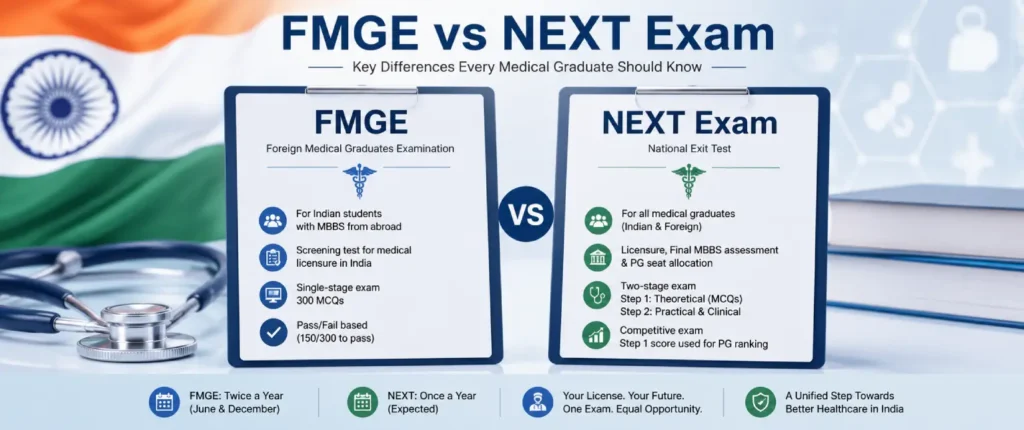
Before diving into the details, here is a quick comparison table that maps out the FMGE vs NExT exam differences at a glance.
| Feature | FMGE | NExT Exam |
|---|---|---|
| Full Form | Foreign Medical Graduates Examination | National Exit Test |
| Conducted By | National Board of Examinations (NBE) | National Medical Commission (NMC) |
| Who Must Appear | Only foreign medical graduates | Both Indian and foreign medical graduates |
| Purpose | Medical licensing only | Licensing + PG admission + final-year assessment |
| Stages | Single stage | Two stages (Step 1 and Step 2) |
| Question Format | 300 MCQs | Step 1: MCQs; Step 2: practical/clinical |
| Passing Marks | 150/300 (50%) | Competitive scoring; Step 1 scores rank candidates |
| Frequency | Twice a year | Once a year (expected) |
| PG Admission Role | None | Yes, Step 1 determines PG ranking |
| Replaced By | NExT Exam | – |
This table gives you the skeleton. Now let us go through each row and understand what it actually means for your career.
FMGE Exam Pattern vs NExT Exam Pattern: What Changed and Why It Matters
The FMGE exam pattern was deliberately simple. One exam. One day. Three hundred multiple-choice questions covering all major medical subjects. You needed to score at least 150 out of 300 to qualify. No sections, No clinical rounds, No rankings. You either passed or you did not.
Many students found comfort in that simplicity even when they failed. You could prepare, reappear, and try again. FMGE was held twice a year, giving two windows annually to clear it.
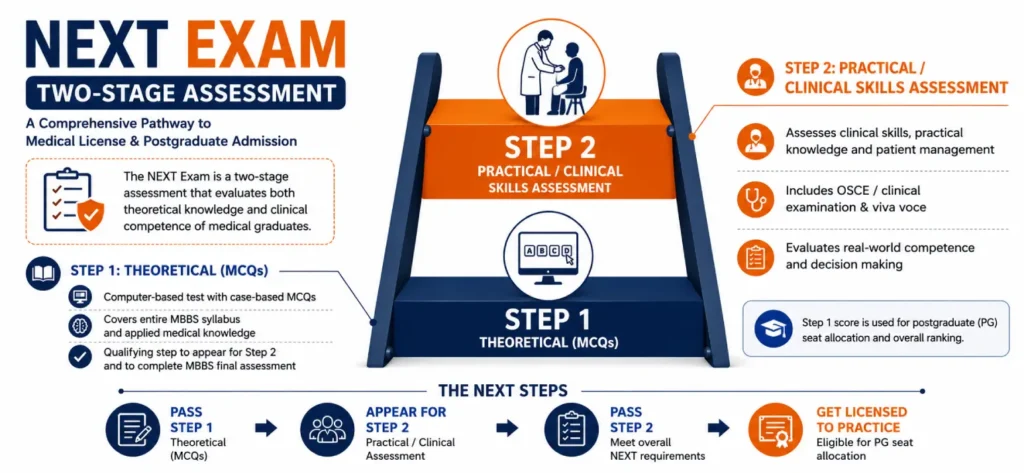
The NExT exam pattern is a different structure entirely. It has two distinct stages.
NExT Step 1 is the theory-based component. It tests medical knowledge through a computer-based MCQ format across all subjects. This stage replaces both the final MBBS university examination and NEET PG. Your Step 1 score is not just a pass or fail mark. It becomes your PG admission score. Every decimal point counts.
NExT Step 2 is the clinical and practical skills assessment. It evaluates your ability to apply knowledge in real patient-care settings. This stage is what separates NExT from FMGE most sharply. FMGE never tested clinical competence in any direct way.
So when you compare FMGE exam pattern with NExT exam pattern, you are really comparing a written screening test with a full-spectrum competency evaluation. The bar has moved significantly.
FMGE Exam Eligibility vs NExT Exam Eligibility: Who Needs What?

This is where most confusion starts. Let us sort it out clearly.
FMGE exam eligibility applied to:
- Indian nationals or OCIs who completed MBBS from a foreign medical institution recognised by the NMC
- Students with a valid internship completion certificate from the foreign university
- Those who had not previously been registered under any State Medical Council in India
That was the full scope. Indian MBBS graduates were never part of this equation.
NExT exam eligibility includes:
- All Indian MBBS students completing their final year from NMC-recognised domestic colleges
- Indian students who completed MBBS from recognised foreign medical universities
- Both categories appear for the same exam under the same framework
This shift in NExT exam eligibility is the most radical change in Indian medical licensing history. For the first time, foreign and domestic graduates compete on a single platform. The FMGE and NExT differences here are not just administrative. They change the entire competitive landscape for foreign medical graduates trying to secure PG seats in India.
Why FMGE Replacement by NExT Was Inevitable
For years, the FMGE pass rate told a sobering story. Students with medical degrees from countries like Russia, China, Ukraine, Kazakhstan, and the Philippines would return to India and then fail the licensing exam at alarmingly high rates. Some passed on the second or third attempt. Many never cleared it.
The underlying problem was not the students. It was the mismatch between what foreign universities taught, what FMGE tested, and what Indian clinical practice actually demanded.
The NMC recognised this gap. The FMGE replacement by NExT was designed to address it structurally. Rather than running a parallel screening system for foreign graduates, India would now hold one unified national exam for all medical graduates. Same standard, Same test, Same competitive pool.
This change also aligned India with global best practices. Countries like the United States (USMLE), United Kingdom (PLAB), and Australia (AMC) already have unified exit tests for all graduates regardless of where they studied. India was simply catching up.
For students currently studying medicine abroad, understanding this FMGE replacement by NExT is not optional. It is the core of your post-graduation planning.
FMGE vs NExT Exam: Career Impact for Foreign Graduates
Passing FMGE meant one thing. You could get a provisional registration with the NMC and start practising medicine in India. No PG seat. No ranking. Just a licence.
Clearing NExT means something far more expansive. Your NExT Step 1 score becomes your PG admission credential. It decides whether you get into MD, MS, or diploma programmes and in which specialty. This is also why NExT exam for MBBS abroad students carries such enormous weight.
Consider the contrast plainly:
- FMGE pass = licence to practise, no PG advantage
- NExT Step 1 high score = licence to practise + competitive PG admission ranking
- NExT Step 2 pass = full permanent registration, clinical competence certified
For any student who studied abroad and wants a postgraduate career in India, the FMGE vs NExT exam shift is genuinely good news. One exam now opens multiple doors that used to require separate processes and separate timelines.
That said, it also raises the stakes. You are now benchmarked against students who spent five and a half years in Indian medical colleges, learning in the exact clinical environment that NExT assesses. Preparation needs to be smarter and more targeted than what FMGE coaching used to require.
FMGE and NExT Differences in Scoring: Pass-Qualify vs Compete-and-Rank
The scoring philosophy of these two exams could not be more different from each other.
FMGE was a qualifying test. The cutoff was fixed at 50%. Score 150 out of 300 and you pass. Score 149 and you fail. There were no merit lists. No rankings. No competitive element beyond that single threshold.
NExT is a competitive exam at its core. The Step 1 score functions like a standardised score that ranks you against every other candidate in the country. A score of 60% and a score of 85% lead to very different PG college options. The FMGE vs NExT comparison here is the equivalent of comparing a pass-fail driving test to a Formula 1 qualifying session. Both test the same vehicle. The outcomes are not remotely comparable.
This scoring difference is also why coaching for the NExT exam demands a different kind of preparation strategy. You are not just trying to cross a line. You are trying to finish as close to the front as possible.
NExT Exam Pattern Deep Dive: NExT Step 1 and Step 2 Explained
Understanding the internal structure of NExT is critical for any foreign graduate mapping out their preparation timeline.
NExT Step 1: Theory Assessment
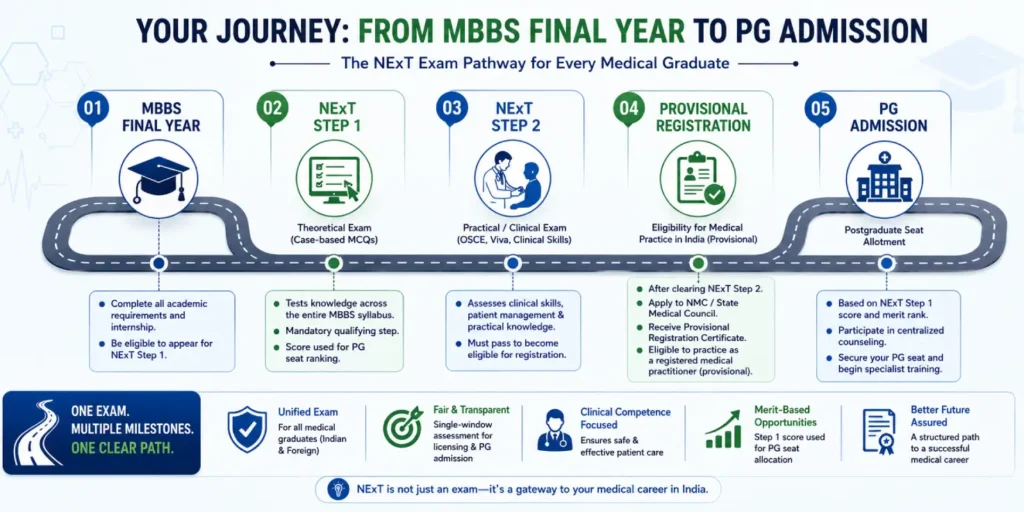
Step 1 is a computer-based exam. It tests foundational and applied medical knowledge across all disciplines. The exam structure draws from the same broad subject areas that FMGE covered, but the depth and competitive intent are entirely different. Step 1 is typically taken at the end of the MBBS final year. For foreign graduates, it will be taken after returning to India with their degree and completing their internship requirements.
The score you receive in NExT Step 1 directly feeds into the merit list for postgraduate admissions. This is why the NExT exam pattern shift from FMGE is so significant. One test now serves both licensing and admission purposes simultaneously.
NExT Step 2: Clinical and Practical Assessment
Step 2 evaluates practical competence. It includes structured clinical examinations, OSPE, and assessments of patient management skills. Passing Step 2 is mandatory to receive permanent registration with the NMC.
For foreign graduates, Step 2 is where clinical exposure during internship becomes genuinely critical. Students who completed internship in India at NMC-recognised hospitals will have a clear advantage here. Students who did not may face additional hurdles.
Together, NExT Step 1 and Step 2 form a complete picture of medical readiness that FMGE never attempted to assess.
How to Prepare for NExT When You Studied Abroad
Preparation for the NExT exam for MBBS abroad students requires a strategic shift from how people used to approach FMGE. Here is what that shift looks like in practice.
For FMGE, most students focused on:
- Covering high-yield MCQ topics quickly
- Targeting the 50% pass mark
- Two-attempt planning over six to twelve months
For NExT, the preparation approach must include:
- Deep subject mastery across all disciplines, not just high-yield spots
- Clinical case-based thinking, not just factual recall
- Competitive score targeting, not just pass-mark targeting
- Step 2 clinical skills preparation as a separate track
The Annamalayar Educational Trust has structured its NExT coaching programmes keeping exactly this shift in mind. Students who studied abroad need focused bridging between the theoretical framework of their foreign university curriculum and the clinical competency framework that NExT demands.
Additionally, staying updated through the NMC’s official guidelines is non-negotiable. The NExT rollout timeline has seen updates, and regulatory clarity matters when you are planning a multi-year preparation path.
Frequency and Timing: How Often Can You Appear?
This is a practical difference that affects planning directly.
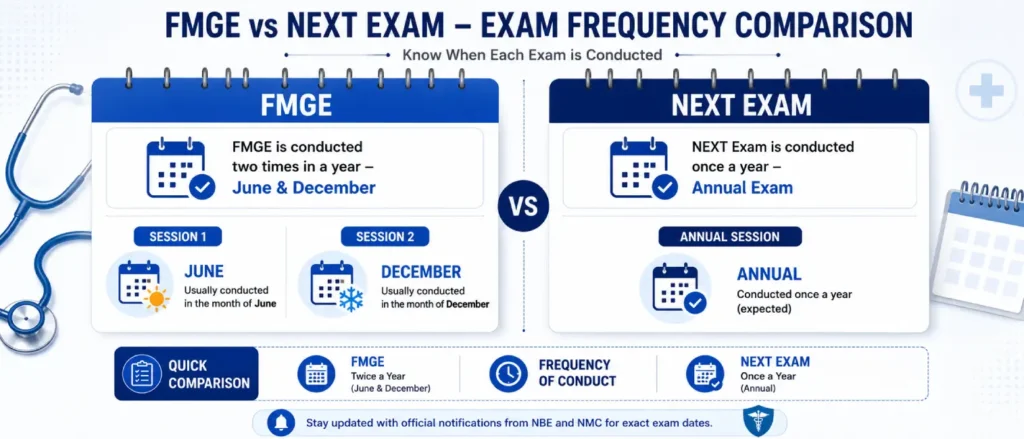
FMGE gave students two chances per year. The exam was typically held in June and December. If you failed in June, you waited six months and tried again in December. That two-window structure gave some flexibility in scheduling your return to India and your internship completion.
NExT is expected to be held once a year. One attempt per annual cycle. That changes the risk calculus entirely.
A single annual window means that preparation cannot be rushed or half-done. You cannot afford to attempt the exam on marginal readiness and bank on the six-month repeat. Each attempt in NExT must be treated as a genuine scoring opportunity, especially given that your Step 1 score feeds into PG seat allocation.
This frequency difference between FMGE and NExT is perhaps one of the most underappreciated practical changes that students studying abroad need to factor into their post-return timelines.
What This Means If You Are Currently Studying Abroad
If you are mid-MBBS in Russia, Ukraine, China, the Philippines, or anywhere else, the FMGE vs NExT exam transition affects your entire return plan. Here is a clear-eyed summary of what you should be doing right now.
First, verify that your university is on the NMC’s approved list. NExT exam eligibility depends on your university holding that recognition at the time of your graduation. An unapproved degree means no NExT eligibility regardless of your preparation.
Second, plan your internship deliberately. NMC mandates that foreign graduates complete a rotating internship at NMC-recognised hospitals in India. The quality of that internship will shape your Step 2 readiness.
Third, begin subject revision early. Do not wait until you land back in India. The FMGE vs NExT comparison makes it clear that you are now in a higher-stakes competitive arena. Early preparation is not optional. It is the smart baseline.
For detailed information on NMC-compliant MBBS abroad pathways, you can also refer to resources on the World Directory of Medical Schools, which is used globally to verify institutional recognition.
FAQs: FMGE vs NExT Exam Questions Answered Directly
Q1. Has FMGE been completely scrapped and replaced by NExT?
Yes, FMGE replacement by NExT is confirmed under the NMC Act, and once fully implemented, all foreign medical graduates will appear for NExT instead.
Q2. If I already passed FMGE, do I still need to appear for NExT?
If you hold a valid medical registration obtained before NExT is implemented, you are considered licensed, but appearing for NExT may be required for postgraduate admission.
Q3. Is NExT exam eligibility different for foreign graduates compared to Indian graduates?
The core criteria are the same, except foreign graduates must additionally confirm their university holds NMC recognition at the time of graduation.
Q4. Can a foreign graduate get a PG seat in India through NExT like Indian graduates?
Yes, foreign graduates who score well in NExT Step 1 compete for PG seats in the same national merit pool as domestic MBBS graduates.
Q5. How does the NExT exam pattern affect preparation compared to FMGE?
Unlike FMGE’s simple 50% pass mark, NExT demands competitive Step 1 scoring plus a separate clinical skills assessment in Step 2, requiring a much longer and deeper preparation plan.
For personalised guidance on NExT coaching for students returning from abroad, explore the programmes at Annamalayar Educational Trust and their dedicated NExT exam coaching page.