Your flight lands in Chennai. The degree from Tbilisi or Tashkent sits safely in your bag. Your parents are proud. Yet one quiet question follows you out of the airport. What now? That single question shapes your entire MBBS Abroad Career in India. The good news is simple. The road is clear once you see it laid out. The bad news is also simple. Most students see it far too late.
So this guide walks you through every stage after you come home from Georgia or Uzbekistan. First you will see the exam. Then you will see the internship and the registration. After that come the jobs and the salary and the postgraduate seats waiting at the end. We also cover what other guides skip. That includes real 2026 FMGE numbers and the internship waiting problem in Tamil Nadu. If you are still choosing a country you can first explore our MBBS abroad programmes. Now let us start where your career truly begins.
Why Your MBBS Abroad Career in India Starts Before You Graduate
Picture a student we will call Priya from Erode. She spent six years in Samarkand. She studied hard and passed every semester. Yet she never checked her paperwork until the final month. Her transcript missed one clinical rotation. That single gap cost her four months back home.
Stories like this are common. Thankfully they are also avoidable. The National Medical Commission (NMC) checks your foreign degree closely. Therefore your MBBS Abroad Career in India really begins in your first year abroad. Our eligibility guide for MBBS abroad covers the entry rules. Meanwhile lock these points down from day one:
- NEET-UG qualified before admission
- Course of at least 54 months
- Plus 12 months internship at the same university
- Teaching fully in English
- Licence to practise in Georgia or Uzbekistan
- Degree finished within 10 years of joining
The 4 Legal Steps to Start Your MBBS Abroad Career in India
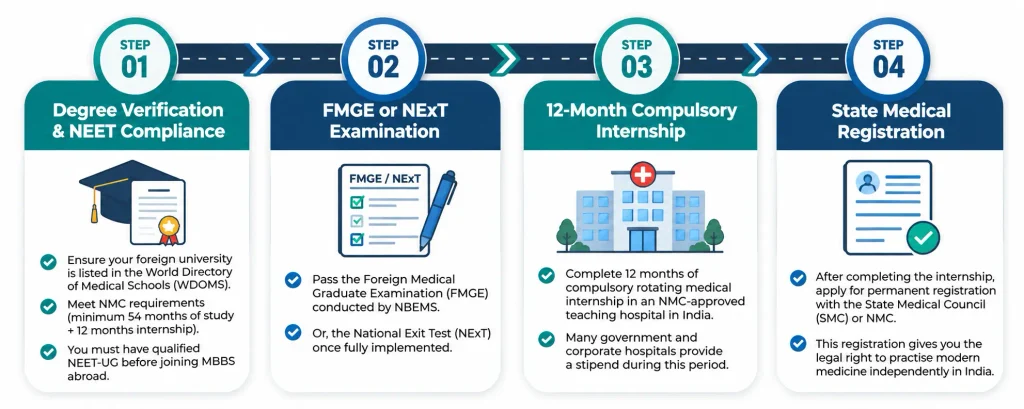
Every Indian student who completes MBBS abroad must meet NMC rules before treating a single patient here. There are no shortcuts. Instead there are four fixed steps.
- Degree Verification: First your foreign medical qualification and university must meet NMC rules. You must also meet NEET-UG eligibility. Then you get your degree and transcripts apostilled or attested.
- Licensing Examination: Next you pass the Foreign Medical Graduate Examination (FMGE). Later the National Exit Test (NExT) will take its place. You clear whichever exam the rules require at that time.
- Compulsory Internship: After that you complete a 12 month Compulsory Rotating Medical Internship (CRMI) in India where applicable.
- Medical Registration: Finally you get permanent registration from your State Medical Council. Only then can you practise legally in India.
Think of these steps as four locked doors. Each key opens only the next door. So skipping ahead is never possible. However planning ahead is always possible. Our breakdown of the NMC guidelines for MBBS abroad explains the rules behind each door.
FMGE Exam for Foreign Medical Graduates: What the 2026 Numbers Really Say
The FMGE Exam for Foreign Medical Graduates is the biggest hurdle on the road home. The National Board of Examinations in Medical Sciences (NBEMS) runs it twice a year. It has 300 multiple choice questions across two parts. You need 150 marks to pass. There is no negative marking. Now look at this year’s results. They tell a story most consultants avoid.
| What the data shows | Figure |
|---|---|
| January 2026 pass rate | 23.9% |
| June 2026 candidates who appeared | 37,448 |
| June 2026 overall pass rate | About 12.4% (12.78% as per the Health Ministry) |
| June 2026 first attempt pass rate | Above 35% |
| Share of repeat candidates in June 2026 | About 88% |
So here is the real lesson. The overall pass rate looks scary. Yet first-time candidates passed at almost three times that rate. Most failures came from repeat attempts. Students who prepare during their degree tend to clear it early. Students who wait until they return often struggle for years. That is why your MBBS Abroad Career in India depends on habits you build abroad. Always check exam notices on the official NBEMS website before each session.

Is NExT Replacing the FMGE Exam for Foreign Medical Graduates?
Not yet. In August 2026 the NMC released a draft amendment. It keeps the FMGE as the qualifying exam for foreign graduates until NExT starts. So you should prepare for the FMGE today. Still keep one eye on NExT. Its two-step format rewards clinical skill more than memory. Our FMGE vs NExT comparison explains both side by side. You can also read how to prepare for NExT while studying abroad. Students who want structured help can join our National Exit Test coaching.
Internship After MBBS Abroad in India: Seats, Stipend and Waiting Time
Passing the FMGE feels like the finish line. It is not. Next comes the Internship After MBBS Abroad in India. This is a 12 month rotating internship at an NMC approved hospital. You rotate through general medicine and surgery. Then paediatrics and obstetrics follow. Community medicine and other postings complete the year.
For years this step caused real pain in Tamil Nadu. Some graduates waited up to two years for a seat. Then July 2026 brought relief. The state approved FMG interns at 23 District Headquarters Hospitals and 13 more government hospitals. As a result FMG internship seats rose to 1,504 from just 384. That change shortens the gap in your MBBS Abroad Career in India.
What about money? The stipend depends on your state. The Supreme Court has backed parity between FMG interns and Indian interns. However states still decide the actual amount. Gujarat for example now pays FMG interns ₹21,840 a month. Quick facts to remember:
- Internship lasts 12 months
- Provisional registration comes first
- Stipend rules vary by state
- Seats fill fast so apply early
- Keep your FMGE pass certificate ready
Medical Registration After MBBS Abroad: Your Document Checklist
Medical Registration After MBBS Abroad happens in two stages. First you get provisional registration to start the internship. Then you earn permanent registration once the internship ends. Both stages need clean paperwork. One missing stamp can stall your file for weeks. Keep these documents ready in originals and copies:
- Primary medical degree certificate
- Full transcript with subject hours
- Internship completion certificate from abroad
- Licence to practise from Georgia or Uzbekistan
- NEET-UG scorecard
- Passport with all visa and entry stamps
- FMGE pass certificate from NBEMS
- Apostille or embassy attestation
One small tip saves a lot of stress. NBEMS has said the online FMGE scorecard cannot replace the pass certificate at the State Medical Council. So collect the physical certificate after in-person verification. Then your MBBS Abroad Career in India moves forward without delay. You can also read the national register rules on the National Medical Commission website.
Month-by-Month Timeline for Your MBBS Abroad Career in India
Parents often ask one question. How long until my child earns a salary? Here is a realistic timeline. It assumes you clear the FMGE on your first attempt.
| Stage | Typical time after return | What happens |
|---|---|---|
| Return to India | Month 0 | Collect degree papers and finish attestation |
| FMGE preparation | Months 0 to 6 | Revise subjects and take mock tests |
| FMGE exam and result | Months 6 to 7 | June or December session |
| Provisional registration | Months 7 to 9 | Apply to your State Medical Council |
| CRMI internship | Months 9 to 21 | 12 month rotation in an Indian hospital |
| Permanent registration | Months 21 to 23 | Full licence to practise |
| First job or NEET-PG | Month 23 onward | Start earning or start a specialty |
Of course delays can stretch this. A failed attempt adds about six months. A slow internship allotment can add more. Still the table gives you a clear target. Families who plan for about two years usually feel far less pressure. Our guide on the education loan for MBBS abroad also helps you plan this gap.
Career Options After MBBS Abroad Once You Are Registered
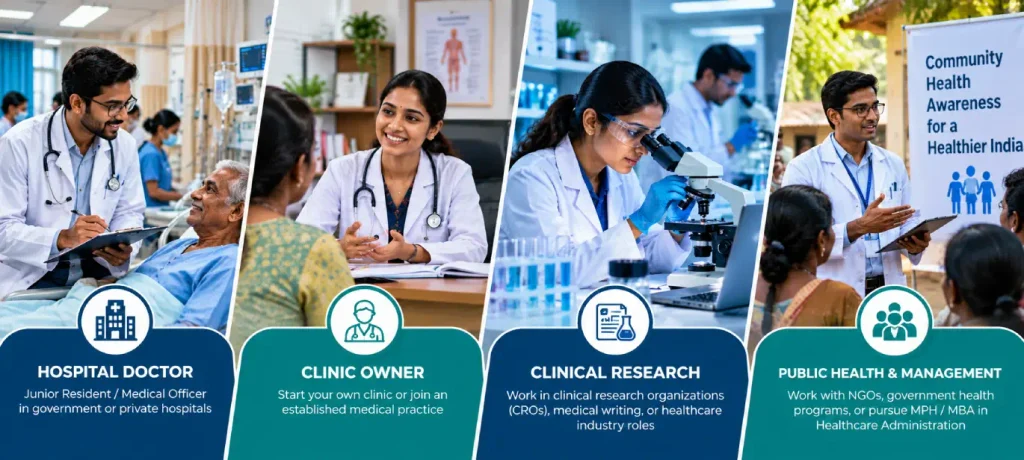
Registration opens every door at once. Here are the main Career Options After MBBS Abroad for registered doctors. Each path suits a different personality. So pick the one that matches your strengths.
Clinical Jobs After MBBS Abroad in India
Most graduates begin in hospitals. You can work as a Junior Resident or a Medical Officer. Duty doctor roles in emergency wards are also common. Government posts come through state recruitment boards. Private hospitals hire all year round. This hands-on start builds your MBBS Abroad Career in India fast.
Private Practice and the MBBS Abroad Scope in India
Some doctors want independence. You can open your own clinic or join an existing practice. Small towns often need doctors badly. So competition there is lower. However you must register the clinic and follow biomedical waste rules. Patient trust matters far more than fancy equipment.
Non-Clinical Career Options After MBBS Abroad
Not every doctor wants night shifts. Thankfully the non-clinical world welcomes medical minds. Popular roles include:
- Medical writing
- Clinical research
- Medical insurance
- Occupational health
- Pharmacovigilance
Public Health and Management Career Options After MBBS Abroad
Do you enjoy systems more than stethoscopes? Then consider an MPH. An MBA in Healthcare or Hospital Administration works too. These roles shape how hospitals and health programmes run. They also pay well as you grow into senior posts.
International Exams Beyond Your MBBS Abroad Career in India
Some graduates look beyond India. USMLE opens the United States. PLAB or the UK MLA opens Britain. The AMC exam opens Australia. Each country sets its own rules. So check eligibility before you spend on coaching. Georgia’s Ministry of Education has confirmed WFME and ECFMG recognition for its MD programmes. That matters for students who dream of the USMLE route.
Postgraduate Courses After MBBS Abroad: MD, MS, DNB and Beyond
Many graduates want a specialty. Postgraduate Courses After MBBS Abroad follow the same route as for Indian graduates. First you need permanent registration and a completed internship. Then you take NEET-PG or the exam that replaces it. Your rank decides your seat. Main choices include:
- MD in medical branches
- MS in surgical branches
- DNB in NBEMS accredited hospitals
- PG diplomas in select fields
- MPH or hospital management degrees
A PG seat changes everything. Specialists earn far more than MBBS doctors. They also reach senior roles faster. So many graduates work for a year or two first. Then they prepare for NEET-PG with a steady income. That balance keeps your MBBS Abroad Career in India stable and growing.
Salary After MBBS Abroad in India: What to Expect at Each Stage
Let us talk money honestly. Salary After MBBS Abroad in India matches what Indian graduates earn in the same role. Your degree country does not change the pay slip. Your role and your city do.
| Role | Approximate monthly pay |
|---|---|
| Intern (CRMI) | Stipend fixed by each state |
| Junior Resident or Medical Officer (private) | ₹40,000 to ₹80,000 |
| Government Medical Officer | ₹60,000 to ₹1,00,000 plus allowances |
| Non-clinical roles | ₹35,000 to ₹90,000 |
| PG Resident (MD, MS or DNB) | ₹50,000 to ₹1,30,000 stipend |
| Specialist after PG | ₹1,50,000 to ₹3,00,000 or more |
These are broad ranges. They shift by state and city and employer. Still the pattern is clear. Pay jumps sharply after a PG degree. So the Salary After MBBS Abroad in India grows with every step you finish. In short every rupee of your MBBS Abroad Career in India follows this ladder.
Georgia vs Uzbekistan: Which Gives Better MBBS Abroad Scope in India?
Both countries lead to the same Indian exams. So the MBBS Abroad Scope in India is equal on paper. The real difference lies in how you train there.
| Factor | Georgia | Uzbekistan |
|---|---|---|
| Course length | 6 years (5 + 1 internship) | 6 years (5 + 1 internship) |
| Medium | English | English |
| Recognition | NMC compliant universities with WFME and ECFMG recognition | NMC compliant universities listed with WHO |
| Clinical exposure | Modern private and state hospitals | Large state hospitals with high patient load |
| Overall cost | Moderate | Lower |
| Campus life | European style | Calm and budget friendly |
| Indian food | SRV Mess support | SRV Mess support |
Uzbekistan suits students who want more patients and lower fees. Georgia suits students who want a European campus and global exam options. Compare universities on our MBBS in Georgia and MBBS in Uzbekistan pages. You can also read about Georgian National University SEU and Tashkent Medical Academy. Either way the right university makes your MBBS Abroad Career in India smoother.
Plan B Jobs After MBBS Abroad in India While You Clear FMGE
Sometimes the FMGE takes two attempts. That is not the end. Many graduates keep earning while they prepare. In fact Jobs After MBBS Abroad in India exist even before registration. These roles do not let you treat patients. Yet they keep your mind in medicine.
- Medical coding
- Medical scribe work
- Clinical research coordinator
- Health content writing
- Healthcare sales support
Choose roles with flexible hours. Then guard four to five study hours every day. That balance keeps your MBBS Abroad Career in India alive during the wait. Above all do not quit preparation for a short-term salary.
5 Mistakes That Slow Down Your MBBS Abroad Career in India
We meet returning graduates every month. Most delays come from the same small errors. None of them are about intelligence. All of them are about planning. Avoid these and you save months.
- Starting FMGE study after return. The fresher pass rate proves early study wins. Begin MCQ practice in your fourth year.
- Ignoring transcript details. Missing subject hours or rotations trigger rejections. Check every page before you leave campus.
- Skipping the local licence. Your licence to practise in Georgia or Uzbekistan is mandatory. Collect it before your flight home.
- Waiting for internship allotment passively. Track state notices weekly. Seats open in batches and fill quickly.
- Chasing quick jobs over preparation. A small salary today can cost you a whole exam cycle.
Each mistake looks minor on its own. Together they can add a full year to your timeline. So treat your paperwork like a clinical case. Check it twice and then check it again.
How Annamalayar Supports Your MBBS Abroad Career in India
At Annamalayar Educational Trust we have guided over 500 students to Georgia and Uzbekistan across more than 20 years. Our support does not stop at the airport. We track FMGE and NExT updates. We guide document attestation. Also we connect students with exam coaching. Families who prefer to study closer to home can explore our International Campus in India. Want the full cost picture first? Read our guide on the hidden cost of MBBS abroad. You can also visit our Coimbatore branch or contact our counsellors for a free session.
The Bottom Line on Your MBBS Abroad Career in India
After MBBS abroad you can choose clinical practice or postgraduate study. You can also choose non-clinical work or an international licence. However one rule never changes. To practise medicine in India you must first clear the licensing exam. Then you finish the internship. After that you complete your Medical Registration After MBBS Abroad with the State Medical Council.
So start early. Study for the FMGE while you are still in Georgia or Uzbekistan. Keep your papers perfect. Plan for roughly two years from return to first salary. Do that and your degree turns into a real career.
FAQs About MBBS Abroad Career in India
Yes. You must clear the FMGE and finish a 12 month internship in India. Then you register with your State Medical Council.
There is no fixed attempt limit right now. Still first-time candidates pass at a much higher rate so aim to clear it early.
Usually yes. Courts have backed parity with Indian interns. Yet each state fixes the actual amount.
Most newly registered doctors earn about ₹40,000 to ₹80,000 a month in private hospitals. Government posts and specialists earn more.
You can take MD or MS or DNB through NEET-PG after permanent registration. MPH and hospital management suit non-clinical goals.